

close
Choose Your Site
Global
Social Media

Author: Site Editor Publish Time: 2026-06-29 Origin: Site
Parents often want high-value outdoor play options to burn their children's boundless energy. However, limited square footage, strict homeowner association (HOA) rules, or landscaping concerns quickly complicate this goal. You might assume a tight yard means skipping large equipment entirely. This assumption is false. A small backyard does not mean you must sacrifice an outdoor playset. It merely requires shifting your evaluation criteria. You must stop looking for maximum overall size. Instead, prioritize maximum play value per square foot.
We need to approach this process realistically. Many marketing campaigns promise their products can "fit anywhere." Do not fall for these exaggerated claims. Every piece of equipment demands realistic spatial requirements. They carry transparent maintenance realities. They also require strict safety clearance standards. By respecting these physical limits, you can build an engaging space. You will keep your kids active without making your yard feel cluttered or unsafe.
Space dictates category: An effective small backyard playset requires prioritizing verticality and modularity over traditional horizontal footprints (e.g., wide swing beams).
Safety zones are non-negotiable: Every playset requires a minimum 6-foot obstruction-free "use zone" in all directions, significantly impacting usable yard space.
Material impacts longevity and aesthetics: Cedar resists rot but requires sealing; powder-coated steel offers high durability with a smaller visual footprint.
Alternative structures work: Climbing domes, vertical playhouses, and compact springless trampolines often provide better ROI for tight spaces than traditional swing sets.
Choosing equipment for restricted areas involves careful calculation. You cannot simply buy the first compact model you see. You must establish firm success criteria before browsing.
You must evaluate features based on their spatial efficiency. We call this the play value versus footprint ratio. High-value features overlap in function. For example, a rock climbing wall doubles as a deck ladder. It provides excellent developmental benefits while demanding zero extra ground space. Conversely, a standalone tire swing scores poorly here. It offers only one activity but requires a massive swing clearance radius. Always prioritize multi-functional vertical elements over single-use horizontal extensions.
Safety clearances dictate your layout. According to American Society for Testing and Materials (ASTM) standards, residential play equipment requires a strict safety perimeter. You must maintain a 6-foot obstruction-free "use zone" around all stationary elements.
Swinging elements require even more space. You need clearance equal to twice the height of the swing beam in both the front and back. To calculate your true space requirement, add 12 feet to both the length and width of the stationary unit. A structure measuring 4 feet by 4 feet actually consumes a 16-foot by 16-foot area in your yard.
Tight yards usually sit close to neighbors. You must consider line-of-sight restrictions and fence proximity rules. Many HOAs limit structure heights or mandate specific setbacks from property lines. A towering fort might violate these rules if it looks directly into a neighbor's window. Furthermore, you must preserve functional adult spaces. If your new equipment swallows the entire patio, the yard becomes unusable for the family. Balance is essential.
Different designs serve different developmental needs. By categorizing the options, you can align your spatial limits against your child's play style.
Tower-style structures dominate the compact market. They build upwards instead of outwards. Manufacturers often place a sandbox, picnic table, or sensory bin directly underneath the main elevated deck.
Pros: They offer high aesthetic value. They easily integrate into existing landscaping. You can scale them by adding modules as children grow.
Cons/Risks: They remain the bulkiest option. They demand strictly level ground to maintain structural integrity.
Many parents now choose freestanding climbers as alternatives to traditional swings. These geometric structures fit neatly into awkward yard corners.
Pros: They boast an extremely compact footprint. They support multiple kids simultaneously. They rapidly develop gross motor skills and grip strength. They are easy to relocate.
Cons/Risks: Galvanized metal tubes heat up intensely in direct summer sun. They also lack shaded play areas entirely.
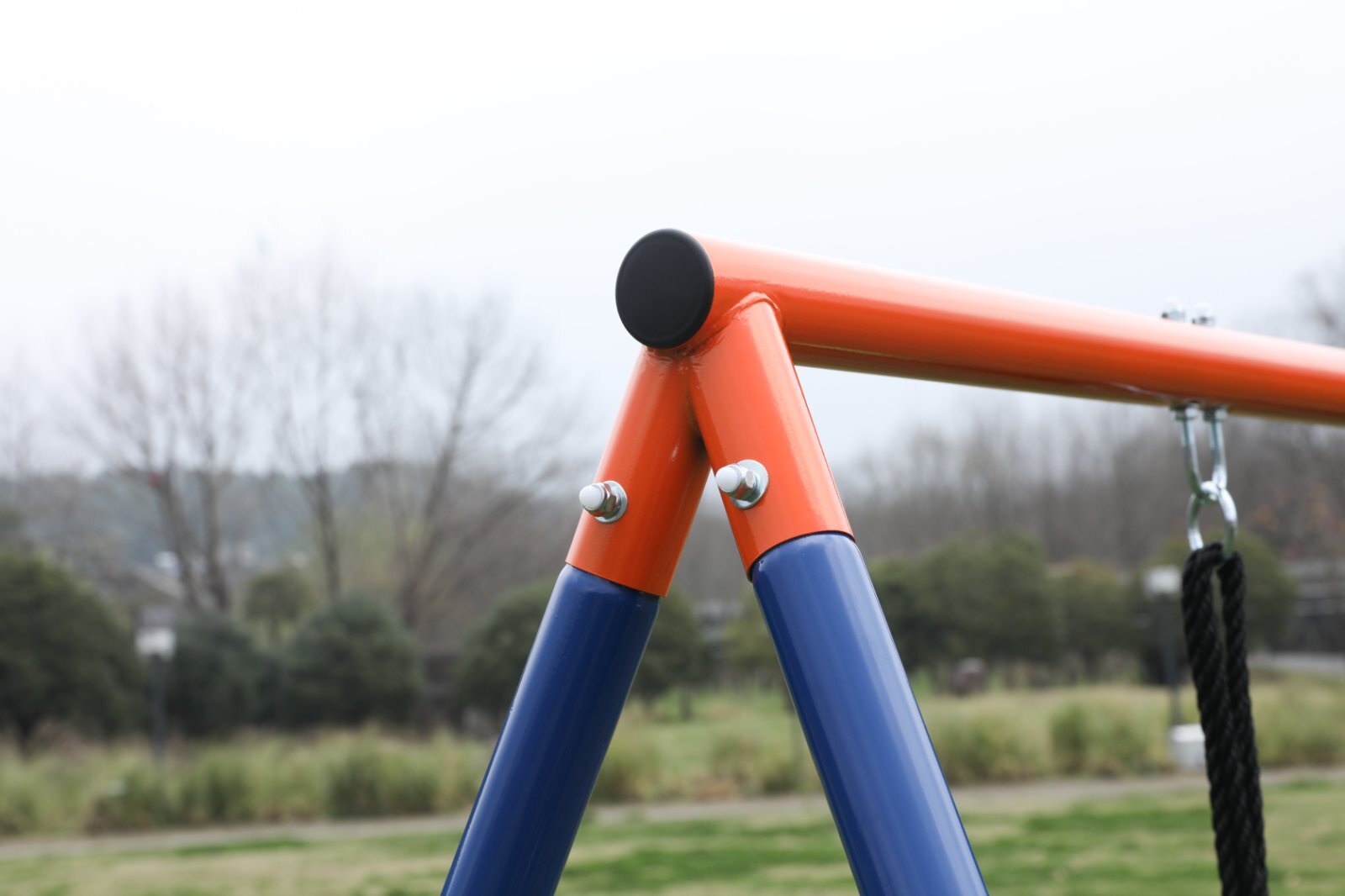
If your child truly loves swinging, you can still find options. Look for reduced-width metal or wood A-frames. These single-bay models support only one or two attachments.
Pros: They deliver the classic, high-energy swing experience within a surprisingly narrow footprint.
Cons/Risks: They offer limited variety. Children may outgrow a single-bay setup much faster than a modular tower.
These units utilize high-grade plastic or resin. They often feature built-in toddler slides, molded steps, and lower crawl spaces.
Pros: They serve toddlers perfectly. They resist harsh weather without rot. They eliminate splinter risks entirely.
Cons/Risks: They carry significantly lower weight limits. Children typically lose interest in them by age six.
Materials dictate both visual appeal and maintenance schedules. In a restricted yard, the structure acts as a focal point. You must choose materials carefully.
Wood remains a classic choice. Cedar acts as a premium option. It naturally resists rot, decay, and insect damage. It looks beautiful alongside high-end landscape designs. However, it requires annual or biennial sealing to maintain its color and integrity. Treated pine offers a cheaper alternative. Unfortunately, pine tends to warp and crack more aggressively under harsh weather conditions.
Metal options provide immense durability. Powder-coated steel resists rust while offering a very sleek, modern appearance. Metal sets utilize thinner support beams compared to thick wooden posts. This creates a smaller visual footprint, making your yard feel less cramped. Aluminum resists rust naturally and weighs less, but steel provides superior anchoring weight for heavy play.
HDPE plastic forms the slides, roofs, and accents of most setups. If you choose an all-plastic toddler center, ensure the material boasts high UV-resistance. Without UV inhibitors, plastic fades rapidly and cracks under prolonged sun exposure. Acknowledge the aesthetic trade-off here. Brightly colored plastics rarely blend into natural landscape designs as seamlessly as wood or dark metal.
Never place equipment directly onto untreated lawn space. Ground preparation ensures long-term safety and structural stability.
Many parents believe standard lawn grass provides adequate cushioning. This is a dangerous myth. Soil compacts over time. Hard-packed dirt fails all impact attenuation standards for fall heights exceeding two feet. A simple tumble from a lower deck onto compacted soil can cause significant injury. You must install proper surfacing.
Different materials require different boundary constraints. Review this comparison chart to guide your choice:
Surfacing Material | Shock Absorption | Maintenance Level | Space Efficiency & Considerations |
|---|---|---|---|
Engineered Wood Fiber (EWF) | Good (at 9-inch depth) | High (Requires frequent raking & top-ups) | Requires timber borders, which eat into small yard space. |
Rubber Mulch | Excellent | Low (Rarely degrades or compacts) | Higher upfront cost, but requires slightly thinner layers than EWF. |
Poured-in-Place Rubber / Mats | Excellent | Very Low (Sweep and wash occasionally) | Best for restricted spaces. No borders needed. Highest upfront investment. |
You must level your ground before installation. Uneven terrain causes structural torque. Over time, this twisting force pulls screws loose and destabilizes joints. Never use wooden shims to level a tall tower. Instead, dig the higher side down to match the lowest point. Finally, you must use ground anchors. Heavy swinging motions can tip unanchored frames, regardless of their total weight.
Following a structured shortlisting process prevents costly mistakes. Use this step-by-step logic to finalize your decision.
Audit the physical constraints. Grab a tape measure. Map out your absolute maximum footprint. Subtract the mandatory 6-foot use zone from all sides. Mark any ground slopes. Note the location of underground utilities before digging.
Map to child age and longevity expectations. Determine your realistic timeline. Decide if you need a three-year solution for a toddler or a ten-year investment for growing kids. This dictates whether you buy plastic modular units or heavy-duty steel.
Budget for comprehensive installation. Look beyond the sticker price. Factor in the unit cost, ground leveling equipment, boundary timbers, and surfacing materials. Include potential professional assembly costs. Hiring experts proves crucial for tight spaces where DIY maneuvering becomes incredibly difficult.
Building an engaging play area in restricted square footage is entirely possible. Accurate measurement and strict adherence to safety zones must precede your aesthetic choices. Once you establish your boundaries, prioritize designs offering a high play value versus footprint ratio.
Remember, a smaller footprint does not limit childhood development. It actually encourages creative engagement when you select the right vertical or climbing-focused outdoor playset. Prioritize durable materials, prepare your ground properly, and respect the clearance rules.
Your next step is simple. Grab a tape measure and physically stake out your yard's dimensions this weekend. Review your local HOA guidelines. Once you know your true limits, you can confidently browse compact collections and build a fantastic play space.
A: You generally need a space measuring at least 16 by 16 feet. A standard compact tower measures roughly 4 by 4 feet. Adding the mandatory 6-foot use zone to all four sides creates this minimum 16-foot footprint. Swinging elements will demand even more length.
A: No. You must grade and level the ground before installation. Placing structures on slopes causes severe torque, leading to loose bolts and structural failure. Never use wooden shims to level the legs, as they pose a massive safety risk.
A: Geometric climbing domes, vertical tower playhouses, sensory water tables, and compact springless trampolines serve as excellent alternatives. They maximize vertical play value and accommodate multiple children without requiring the massive horizontal clearance that traditional swing beams demand.
A: It varies heavily by municipality and HOA. Many local governments do not require permits for standard residential play equipment. However, structures exceeding specific heights or roof footprints often trigger zoning rules. Always check your local guidelines proactively before purchasing.


