

close
Choose Your Site
Global
Social Media

Author: Site Editor Publish Time: 2025-12-05 Origin: Site
When choosing a trampoline for your backyard, the shape matters more than you think. Should you opt for a round or rectangular trampoline? Each offers unique advantages depending on your needs, such as performance, safety, or space efficiency. In this article, we’ll explore the benefits of each shape to help you make an informed choice. You’ll also discover why rectangular trampolines, especially those from Zoshine, are ideal for long-lasting performance and durability.
Round trampolines are often placed centrally in a yard, taking up space in all directions. They work best in open areas, where the trampoline can serve as a focal point. However, this layout can become a challenge in smaller or oddly shaped yards, as the circular design may dominate the available space. Rectangular trampolines, on the other hand, fit more efficiently in long or narrow yards. Their angular design allows them to be tucked into corners or placed along a wall, optimizing the space. For families or homeowners with limited backyard space, a rectangular trampoline makes the most of every square inch.
Feature | Round Trampoline | Rectangular Trampoline |
Space Required | Typically placed centrally, requires space in all directions | Fits more efficiently in corners or along edges |
Ideal Yard Shape | Open or circular yards | Narrow or irregularly shaped yards |
Optimal Use of Space | Less efficient for smaller yards | Maximizes space, ideal for smaller yards |
Safety is a top priority, especially when children are involved. Round trampolines naturally encourage jumpers to stay in the center of the mat, thanks to the pull toward the middle. This safety feature makes round trampolines ideal for younger children who are still learning how to balance. On the other hand, rectangular trampolines offer more space to jump but lack the central gravitational pull, which can lead to users falling off the edges if they venture too far. However, when combined with safety nets and padding, rectangular trampolines can be just as safe as round ones, especially for families with older children or those using it for multiple jumpers.
Rectangular trampolines are widely recognized for offering a superior bounce. The springs are arranged in a way that provides an even, controlled bounce across the entire mat. This even distribution makes rectangular trampolines the ideal choice for athletes, gymnasts, or anyone who requires precision for advanced moves. Round trampolines, by contrast, offer a consistent bounce only in the center. While this is fine for casual use, the bounce quality can be less predictable as you move toward the edges. This is especially true for those attempting advanced flips or performing stunts.
Round trampolines have limited space due to their circular design. While there’s enough space for casual jumping, round trampolines restrict movement for multiple users or for anyone performing advanced maneuvers. In contrast, rectangular trampolines offer a larger jumping surface, making them ideal for multiple users, gymnasts, or those practicing flips and other advanced moves. The extra space ensures that jumpers have enough room to perform without worrying about interfering with others or running out of space.
Feature | Round Trampoline | Rectangular Trampoline |
Bounce Consistency | Best in the center; less predictable near edges | Even, controlled bounce across the entire mat |
Jumping Space | Limited to central area | Larger surface for multiple users or advanced moves |
Ideal for Advanced Moves | Less suitable for advanced tricks | Perfect for gymnasts and athletes requiring more room and control |
Round trampolines tend to be more affordable due to their simpler design and wider availability. They’re a good option for families who want a trampoline for general recreational use without breaking the bank. These trampolines are easy to find in a variety of sizes and generally have a lower upfront cost. Rectangular trampolines, on the other hand, are typically more expensive because of their larger size, higher-quality materials, and the performance benefits they offer. While the initial cost may be higher, a rectangular trampoline often provides better long-term value if you plan to use it regularly for sports or advanced activities.
For families with young children, a round trampoline is typically the best choice. The central pull makes it safer for younger users, and the gentler bounce quality is ideal for recreational jumping. Round trampolines also tend to be smaller, making them easier to place in a yard without taking up too much space. However, for families with multiple children or for those planning to use the trampoline for both kids and adults, a rectangular trampoline may be a better option. Its larger surface allows for more jumpers, and the consistent bounce is beneficial for more dynamic activities. For younger children, it’s essential to ensure safety nets and pads are in place.
If you’re serious about gymnastics, acrobatics, or athletic training, a rectangular trampoline is the better choice. The larger surface area allows for more complex jumps and routines, while the even, predictable bounce provides the precision required for executing advanced moves. Rectangular trampolines also allow for better training conditions, mimicking the performance found in professional settings. The durability and increased space make them the go-to trampoline for athletes seeking long-term use.

Round trampolines are generally easier to maintain due to their symmetrical design. Their springs are uniformly distributed, making it easier to spot any issues with wear and tear. Regular maintenance like checking for rust on the springs, inspecting the frame, and ensuring the mat is intact will help prolong the life of your trampoline. Rectangular trampolines, though, might require more frequent checks, particularly around the edges where the most strain occurs. If used intensively, especially by athletes, the frame and springs may experience uneven wear, and attention must be given to these areas to prevent damage.
Rectangular trampolines are typically built to last longer than round ones due to their reinforced frames and higher-quality materials. These trampolines are designed to withstand higher impact and are more durable over time. If you’re using the trampoline for intense activities like gymnastics or regular athletic training, the durability of a rectangular trampoline is crucial for long-term performance.
Round trampolines provide a gentler, smoother bounce, which is ideal for beginners or casual users who don’t need precision or height. The bounce is more forgiving, making it easier for young children and new jumpers to enjoy the experience without feeling out of control. Rectangular trampolines offer better control and a firmer bounce, ideal for more advanced users or athletes who require higher performance. The predictable bounce quality also allows for better execution of flips, twists, and other complex movements.
Round trampolines are often ideal for casual jumping and recreational use. They are easy to use, require less effort to maintain, and offer a simple fun experience for all ages. However, for more athletic or gymnastics-focused training, a rectangular trampoline provides more flexibility, allowing users to practice more advanced skills and accommodate more than one user at a time.
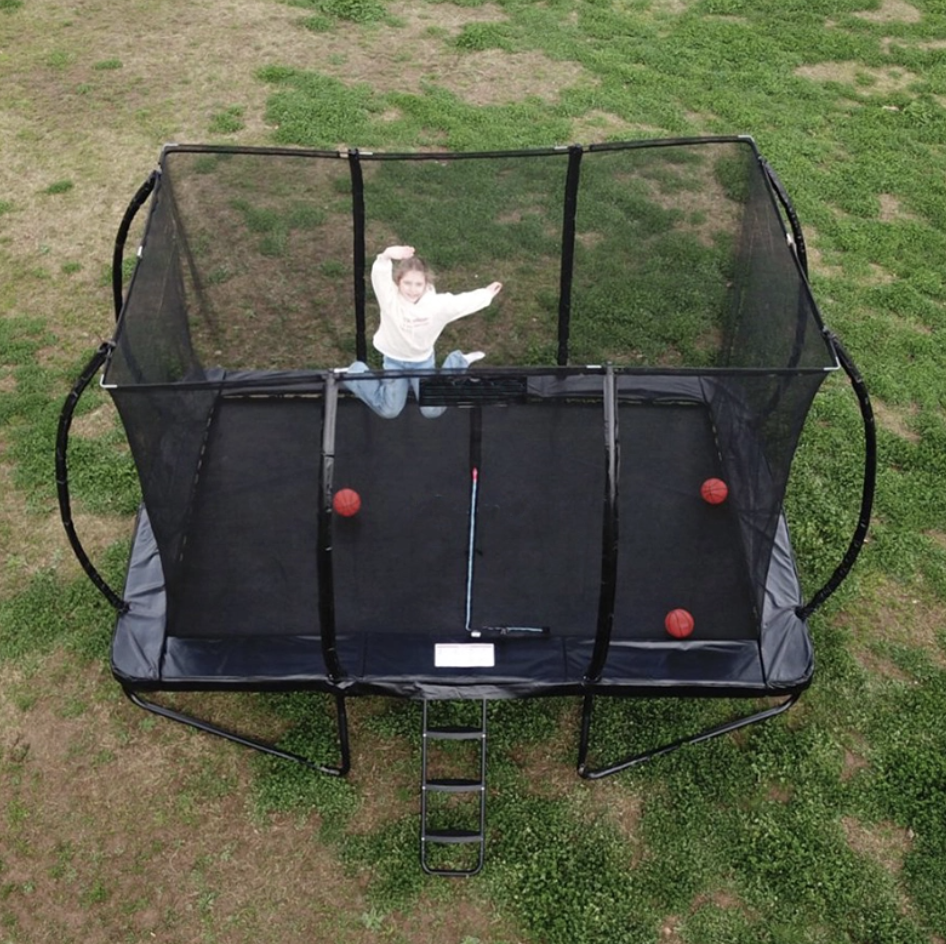
Round trampolines have a traditional look that blends well in most garden settings. They are simple, functional, and not too visually intrusive. However, they may not add much to the overall design of the yard. Rectangular trampolines, with their sleek, angular design, offer a more modern look. These trampolines can act as a design feature in contemporary landscaping, complementing a minimalist or modern backyard layout.
Rectangular trampolines offer the advantage of being tucked into corners or placed along the edge of a yard, making them easier to integrate into a clean, organized design. Round trampolines, on the other hand, require more open space and are more difficult to place in areas with limited room.
In conclusion, the choice between a round or rectangular trampoline depends on your specific needs. Round trampolines are perfect for families with young children, offering safety, simplicity, and ease of maintenance. They are an affordable option for casual use. Rectangular trampolines, though more expensive, provide superior performance, larger jumping space, and enhanced durability. They are ideal for athletes or gymnasts. Zoshine offers high-quality rectangular trampolines that deliver excellent performance and long-lasting value, making them an ideal investment for any backyard.
A: The main difference is in shape. Round trampolines have a circular design and are best for casual use. Rectangular trampolines offer more jumping space and provide better performance for athletes or gymnasts.
A: Round trampolines are generally safer for younger children due to their central pull, which encourages users to stay in the center. Rectangular trampolines can also be safe with proper safety nets and supervision.
A: Rectangular trampolines provide a larger surface area, making them ideal for multiple users. Round trampolines are limited in space and can become crowded with more jumpers.
A: Yes, rectangular trampolines are typically more expensive due to their larger size and better performance features. However, they offer long-term value and durability, making them a worthwhile investment.


