

close
Choose Your Site
Global
Social Media

Author: Site Editor Publish Time: 2026-02-03 Origin: Site
In recent years, the Rectangle Trampoline has become a preferred choice for adults and teens who want more than basic backyard entertainment. Families now look for an outdoor trampoline that supports higher body weight, intense movement, and long-term use. Compared with entry-level options, heavy duty rectangle designs focus on strength, stability, and controlled performance. In this article, you will learn how a rectangle trampoline meets real-world demands and how to choose a model built for durability, safety, and consistent use over time.
A rectangle trampoline delivers an even bounce across the entire jumping area. Unlike round designs, energy does not pull users toward the center. This consistency matters for adults and teens who land with more force. It helps them control motion and maintain rhythm. For fitness routines or repeated drills, predictable rebound reduces strain. Many professional trainers prefer this design because it supports structured movement. In an outdoor trampoline setup, this uniform bounce also improves confidence, especially during higher jumps.
Control is a major reason adults choose a rectangle trampoline. The spring layout works independently along each side, producing stronger vertical lift. This helps heavier jumpers achieve clean takeoff and stable landings. Teens practicing coordination or advanced moves benefit from this lift. Adults using the trampoline for exercise gain better posture control. The design allows users to decide where to land instead of being redirected. Over time, this improves balance and body awareness during repeated sessions.
The rectangular shape offers practical advantages beyond bounce quality. It fits more efficiently into long or narrow backyards. Many outdoor trampoline buyers find it easier to align with fences or walls. The usable surface area feels larger, even at similar sizes. This makes it suitable for shared use by teens and adults. The design also supports linear movement, which suits fitness drills and training routines. These benefits explain why rectangle trampoline models dominate professional and home training spaces.
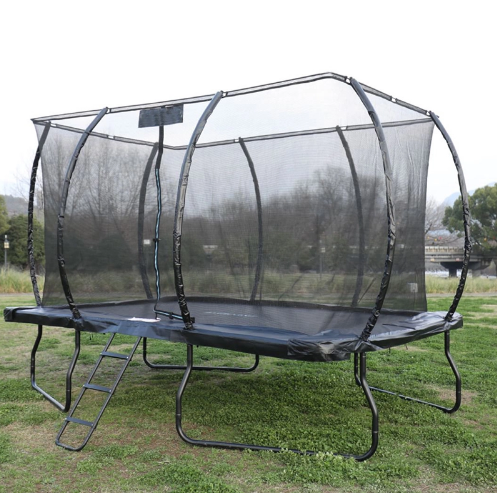
Frame strength defines whether a trampoline can handle adult use. Heavy duty rectangle trampoline frames use thick, galvanized steel tubing. This material resists rust and deformation during repeated impact. The reinforced joints distribute force evenly across the structure. For an outdoor trampoline exposed to weather, galvanization protects long-term integrity. Adults jumping regularly place higher stress on corners and legs. A strong frame ensures stability and keeps the trampoline level during intense movement.
Springs play a critical role in performance and safety. Heavy duty rectangle trampoline models use longer, high-tension springs. These springs stretch smoothly and return energy efficiently. For adults and teens, this reduces harsh rebound. It also protects joints during repeated landings. High-quality springs maintain elasticity longer, even under higher loads. In an outdoor trampoline, coated springs also resist corrosion. This combination supports consistent bounce and extends the usable life of the system.
The jumping mat absorbs direct impact from the user. Heavy duty rectangle trampoline mats use tightly woven polypropylene or similar fabrics. These materials resist tearing and UV damage. Strong stitching prevents edge separation over time. For teens practicing daily or adults using the trampoline for workouts, mat durability is essential. In outdoor trampoline environments, sun exposure can weaken fabric. High-grade mats maintain tension and surface integrity, ensuring reliable performance through years of use.
Static and dynamic load ratings describe very different stress conditions on a trampoline. Knowing how each value is defined, tested, and applied helps buyers judge whether a rectangle trampoline can truly support adult and teen use during real jumping, not just on paper.
| Dimension | Static Load Rating | Dynamic Load Rating | Practical Meaning for Buyers |
|---|---|---|---|
| Definition | Maximum weight the frame supports without movement | Maximum safe user weight during jumping motion | Dynamic load reflects real use conditions |
| Load State | Stationary, evenly distributed | Moving, impact-based, cyclic | Jumping creates peak forces far above body weight |
| Typical Test Method | Dead weight placed on frame (sandbags or steel blocks) | Repeated drop or jump simulation tests | Dynamic tests better represent outdoor trampoline use |
| Force Characteristics | Constant vertical force | Variable force with acceleration and deceleration | Impact force can reach 3–5× body weight |
| Units Commonly Used | kg or lb (static mass) | kg or lb (rated jumper weight) | Same units, very different implications |
| Typical Adult Rectangle Trampoline Values | 700–800 kg (≈1500–1800 lb) | 200–280 kg (≈440–620 lb) | High static values alone are not sufficient |
| Frame Stress Location | Evenly across legs and frame rails | Concentrated at corners, springs, and joints | Rectangle designs must reinforce corners |
| Relation to Shock Absorption | Indirect | Direct indicator | Higher dynamic rating means better energy dissipation |
| Relevance to Repeated Jumps | Low | High | Fatigue failure is driven by dynamic loading |
| Safety Margin Purpose | Prevent structural collapse at rest | Prevent deformation, spring failure, or instability | Dynamic margin protects long-term performance |
| Common Buyer Misunderstanding | Seen as the main strength indicator | Often overlooked | Static load is easier to inflate in marketing |
| Best Use in Selection | Secondary reference | Primary decision factor | Buyers should prioritize dynamic capacity |
| Impact on Longevity | Limited | Significant | Higher dynamic rating extends service life |
| Application Scenarios | Storage, assembly, idle conditions | Adult fitness, teen training, frequent use | Outdoor trampoline buyers should focus here |
Tip:When choosing a rectangle trampoline for adults or teens, always compare dynamic load ratings first. A model with very high static capacity but low dynamic rating may feel stiff at rest yet degrade faster under real jumping conditions.
A higher weight rating usually signals stronger materials. It improves stability during landing and reduces frame movement. Adults feel safer when the trampoline does not flex excessively. Teens gain confidence to practice skills without imbalance. In group use, higher capacity also supports shared jumping under controlled conditions. For families, this means fewer restrictions. A rectangle trampoline with strong load performance delivers smoother sessions and consistent feel across different user weights.
Many households expect shared use. Heavy duty rectangle trampoline designs support this expectation. Reinforced frames and distributed spring tension help manage combined load. While controlled use is always recommended, these trampolines remain stable during rotation or supervised multi-user sessions. For an outdoor trampoline placed in family spaces, this flexibility adds value. It also reduces wear by spreading impact across the structure instead of stressing one area repeatedly.
Adults increasingly use trampolines for low-impact cardio. A rectangle trampoline provides space for jogging steps, balance drills, and interval training. The even bounce reduces joint stress. This makes workouts sustainable over time. For outdoor trampoline users, fresh air enhances motivation. Fitness trainers often recommend rectangular designs for structured routines. The surface supports consistent foot placement, which helps maintain tempo and posture during longer sessions.
Teens involved in sports benefit from the precision of a rectangle trampoline. The straight edges align with training patterns used in gymnastics and cheer. This allows practice of jumps, twists, and timing. The predictable rebound helps teens focus on technique. Many training programs use similar setups. At home, an outdoor trampoline with this design bridges recreational play and skill development. It supports progression without constant equipment changes.
Professional rebound quality depends on energy return. Heavy duty rectangle trampoline systems combine strong frames, quality springs, and tensioned mats. This combination produces lift without harsh snap. Users feel smooth acceleration and controlled descent. Adults appreciate reduced fatigue. Teens experience better air awareness. For serious users, this rebound quality mirrors training facilities. It also remains consistent longer, even with frequent outdoor use.
Safety enclosures prevent contact with springs and frame edges. No-gap systems attach the net directly to the mat. This design suits adults and teens who jump higher and move faster. It eliminates exposed areas during landing. In an outdoor trampoline, wind resistance and tension matter. Strong net materials and secure attachments ensure enclosure stability. These systems support confident use without interrupting movement flow.
Padding protects high-impact zones. Heavy duty rectangle trampoline padding uses thick foam with weather-resistant covers. Enclosure poles feature internal supports and soft sleeves. Together, these elements reduce injury risk. For teens practicing repeatedly, this protection supports longer sessions. Adults also benefit from added reassurance. Integrated safety systems reflect thoughtful design rather than add-on accessories.
Safety is not only about barriers. Structural stability improves landing control. When the frame remains firm, users adjust body position more easily. This reduces awkward landings. Confidence grows as users trust the equipment. In outdoor trampoline settings, consistent footing also helps during temperature changes. Heavy duty design supports predictable response, which directly influences safe movement.
Effective layout planning starts with load distribution and movement patterns. Rectangle trampolines align naturally with linear spaces, allowing longer jump paths. Placing the long side parallel to fences improves spatial efficiency and airflow. Ground slope should stay within two degrees to maintain frame balance. Using impact-absorbing ground surfaces around the perimeter further improves stability and long-term structural performance in outdoor installations.
Adult and teen jumpers generate greater vertical displacement and lateral drift. A clearance zone equal to at least half the trampoline length on each side helps prevent contact during off-center landings. Overhead space should account for peak jump height plus arm extension. Consistent clearance reduces abrupt stopping forces, supporting safer landings and smoother motion during repeated high-energy use.
Shared use benefits from surface zoning. Longer rectangle trampolines allow natural rotation areas, distributing impact across the mat. This reduces localized fabric fatigue and spring overload. Selecting a size that exceeds minimum user requirements improves flexibility as children grow. It also supports mixed-weight use, ensuring stable performance whether used by teens, adults, or both in sequence.
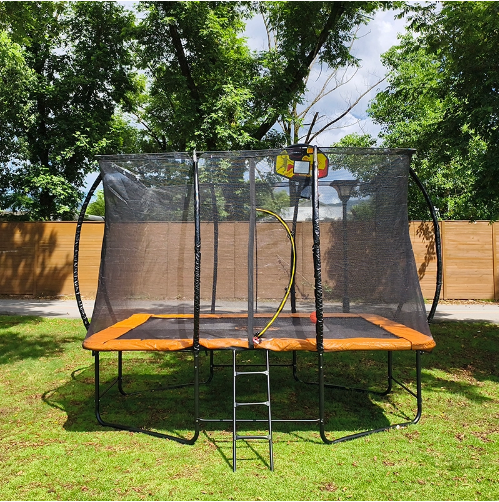
Heavy duty rectangle trampoline systems are engineered around higher fatigue thresholds. Thicker steel tubing improves resistance to cyclic stress, while reinforced corner joints reduce metal fatigue caused by repeated high-impact landings. Advanced powder coating and galvanization slow oxidation in humid or coastal environments. These design choices help preserve frame geometry, spring alignment, and mat tension over years of outdoor use, ensuring consistent rebound performance and structural integrity across different seasons.
Stronger materials directly reduce routine maintenance needs. Galvanized frames limit surface corrosion, lowering the need for repainting or rust treatment. UV-stabilized jumping mats maintain elasticity under prolonged sun exposure, delaying fabric replacement. High-carbon springs retain tension through repeated load cycles, reducing adjustment frequency. Together, these features create a more predictable maintenance schedule, making heavy duty outdoor trampoline ownership easier for families, schools, and training facilities.
When evaluating long-term value, cost per use is more meaningful than the upfront price alone. By comparing structural lifespan, component durability, maintenance frequency, and real-world applications, the long-term economic advantage of a heavy duty rectangle trampoline becomes clear, especially for adults, teens, and training-oriented households.
| Evaluation Dimension | Heavy Duty Rectangle Trampoline | Standard Recreational Trampoline (Reference) | Impact on Cost-per-Use |
|---|---|---|---|
| Intended Use | Adults, teens, frequent training and fitness | Children or occasional leisure use | Design intent directly affects lifespan and usable years |
| Dynamic Weight Capacity (Single User) | 200–280 kg (≈440–620 lb) | 100–150 kg (≈220–330 lb) | Higher capacity reduces material fatigue under repeated impact |
| Static Load Capacity | 700–800 kg (≈1500–1800 lb) | 300–450 kg (≈660–990 lb) | Greater safety margin improves long-term structural stability |
| Frame Material | Hot-dip galvanized steel, 2.0–3.0 mm wall thickness | Powder-coated steel, 1.2–1.5 mm wall thickness | Thicker steel significantly extends frame service life |
| Spring Type and Length | High-carbon steel springs, 210–250 mm | Standard steel springs, 140–170 mm | Longer springs lower peak impact forces and wear |
| Spring Count (10×17 ft class) | 120–170 springs | 60–90 springs | Load distribution reduces stress per spring |
| Jumping Mat Material | High-density PP (Permatron-type), 8–10 stitch rows | Standard PP, 6–8 stitch rows | Higher tensile strength delays deformation |
| UV Resistance | UV-stabilized, maintains performance 3–5 years outdoors | Basic treatment, visible degradation in 1–2 years | Fewer replacements in outdoor trampoline use |
| Typical Service Life | 8–12 years under frequent use | 3–5 years | Longer lifespan lowers annualized cost |
| Annual Maintenance Needs | Low: inspection and minor tightening | Moderate: more frequent spring or mat replacement | Reduced labor and spare part costs |
| Primary Application Scenarios | Long-term family use, fitness, teen skill training | Occasional backyard entertainment | Professional use cases justify higher durability |
| Overall Cost Efficiency | Higher initial price, lower annual cost | Lower initial price, higher total cost over time | Heavy duty models show clear advantage after 3–4 years |
Tip:If the trampoline is used more than three times per week or includes adult users, investing in a heavy duty rectangle trampoline typically pays off over time. The added structural margin and component lifespan often offset the higher upfront cost within a few years of regular use.
A Heavy Duty Rectangle Trampoline for Adults and Teens delivers long-term value through strength, stability, and consistent performance. Its reinforced frame, responsive springs, and reliable safety systems support fitness, training, and shared family use. Products from Zhejiang Zoshine Sports Equipment Co., Ltd. are designed to meet these needs, offering durable construction, high load capacity, and thoughtful engineering that help users enjoy safer, more confident outdoor activity over time.
A: A Rectangle Trampoline is built for adults and teens, offering higher weight capacity, stronger frames, and stable bounce for outdoor trampoline use.
A: A Rectangle Trampoline provides even bounce, better control, and more usable space for fitness and training.
A: Yes, a Rectangle Trampoline supports adult weight, repeated jumps, and long-term outdoor trampoline activity.
A: A Rectangle Trampoline costs more upfront but offers better cost-per-use over time.
A: A Rectangle Trampoline supports gymnastics, cheer practice, and controlled skill development.
A: An outdoor Rectangle Trampoline needs regular inspection, cleaning, and basic hardware checks.


