

close
Choose Your Site
Global
Social Media

Author: Site Editor Publish Time: 2026-06-29 Origin: Site
Purchasing playground equipment transforms an ordinary backyard into a hub of childhood joy and physical development. However, it represents a significant investment requiring careful alignment of available space, budget limits, and strict safety guidelines. Many parents experience immediate decision fatigue when they first begin shopping. You must navigate varying material claims, complex modular add-ons, and often hidden site preparation requirements. Simply picking the most attractive design can lead to safety hazards or cramped play zones if you ignore structural nuances.
This article provides an evidence-based framework for evaluating, shortlisting, and preparing for a new playset. We will explore how to measure safe use zones accurately, compare construction materials, and understand essential ground surfacing standards. You will learn everything needed to select a backyard play system that meets current safety guidelines and adapts seamlessly as your children grow.
Measure for the "Safe Use Zone," not just the footprint: Standard safety guidelines require a minimum 6-foot clearance around all play equipment.
Material dictates maintenance: Wood offers traditional aesthetics but requires annual sealing; vinyl-coated wood and galvanized metal reduce upkeep but carry higher upfront costs.
Factor in surfacing and site prep: The play structure is only half the budget; yard leveling and shock-absorbing ground cover (like rubber mulch or engineered wood fiber) are mandatory for safety compliance.
Prioritize modularity: Sets with interchangeable swing beams and scalable deck heights prevent the system from becoming obsolete as children grow.
Before you purchase a kids backyard swing set, you must understand your spatial limitations. The physical footprint alone only tells part of the story. You must account for the safe use zone to prevent dangerous accidents.
Defining the Equipment Footprint: Manufacturers list product dimensions as length, width, and height. These numbers represent the static structure only. They do not include the dynamic space children need to run, jump, or dismount safely. Always mark these base dimensions in your yard first using landscaping paint.
The ASTM 6-Foot Rule: The American Society for Testing and Materials (ASTM) sets strict playground standards. They require a minimum 6-foot obstacle-free perimeter extending in all directions from the play equipment. This buffer prevents painful collisions. You must keep this specific zone entirely clear of fences, tree trunks, retaining walls, and hardscape features.
Swing Trajectory Clearance: Swings demand considerably more space than static towers. You must calculate the clearance needed directly in front of and behind the swing arcs. Industry standards dictate clearing a distance equal to twice the height of the swing beam. For example, a 7-foot high swing beam requires 14 feet of clearance forward and 14 feet backward.
Evaluating Yard Topography: A perfectly flat yard proves non-negotiable for safe installation. Evaluate your yard's slope meticulously. A slope exceeding 1 to 2 inches over a 20-foot span creates dangerous instability for heavy wooden frames. You will require professional yard leveling to fix steep grades. Alternatively, some manufacturers offer specialized extended A-frame legs to accommodate minor slopes. Address these topography issues long before installation begins.
Material selection heavily influences how much weekend time you dedicate to upkeep. Each option presents unique benefits and distinct drawbacks. We recommend weighing your local climate alongside your personal maintenance tolerance.
These natural woods offer classic backyard aesthetics. They naturally resist rot, decay, and insect damage. Wood stays pleasantly cool in direct sunlight, protecting bare skin. The heavy base weight also adds excellent structural stability during high winds.
However, natural wood demands consistent upkeep. You must stain and seal the structure annually to prevent splintering and premature graying. Natural checking, which presents as visible surface cracks along the grain, frequently occurs. While structural engineers consider checking harmless, it bothers some owners aesthetically.
This premium option encases standard solid lumber inside a thick, protective vinyl sleeve. It completely eliminates the risk of splinters. It offers exceptional weather resistance. You get the reliable structural integrity of thick wood without the dreaded sanding and staining routines.
Unfortunately, it sits in the highest price tier. Internal moisture also becomes a serious hidden risk. If a lawnmower or sharp yard tool punctures the vinyl sleeve, rainwater gets trapped inside. This trapped moisture can cause unseen internal rot over several seasons.
Metal sets remain totally immune to wood rot and boring pests. They require significantly lower maintenance than raw wood alternatives. They usually weigh less, making them much easier to maneuver and assemble.
Conversely, metal retains heat rapidly. Slides, platforms, and handrails can become uncomfortably hot in direct summer sun. You must also monitor the frame for deep scratches. If the protective powder coating chips, the exposed hardware joints will rust quickly in humid environments.
Playset Material Comparison Overview
Material Type | Primary Advantage | Primary Drawback | Maintenance Level |
|---|---|---|---|
Cedar / Redwood | Natural rot resistance and cool surface | Prone to splintering and checking | High (Annual sealing required) |
Vinyl-Coated Wood | Zero splinters and no staining needed | High cost; risk of internal hidden rot | Low (Periodic washing only) |
Galvanized Steel | Immune to rot; lighter weight frame | Retains high heat in summer sun | Medium (Touch-up paint for scratches) |
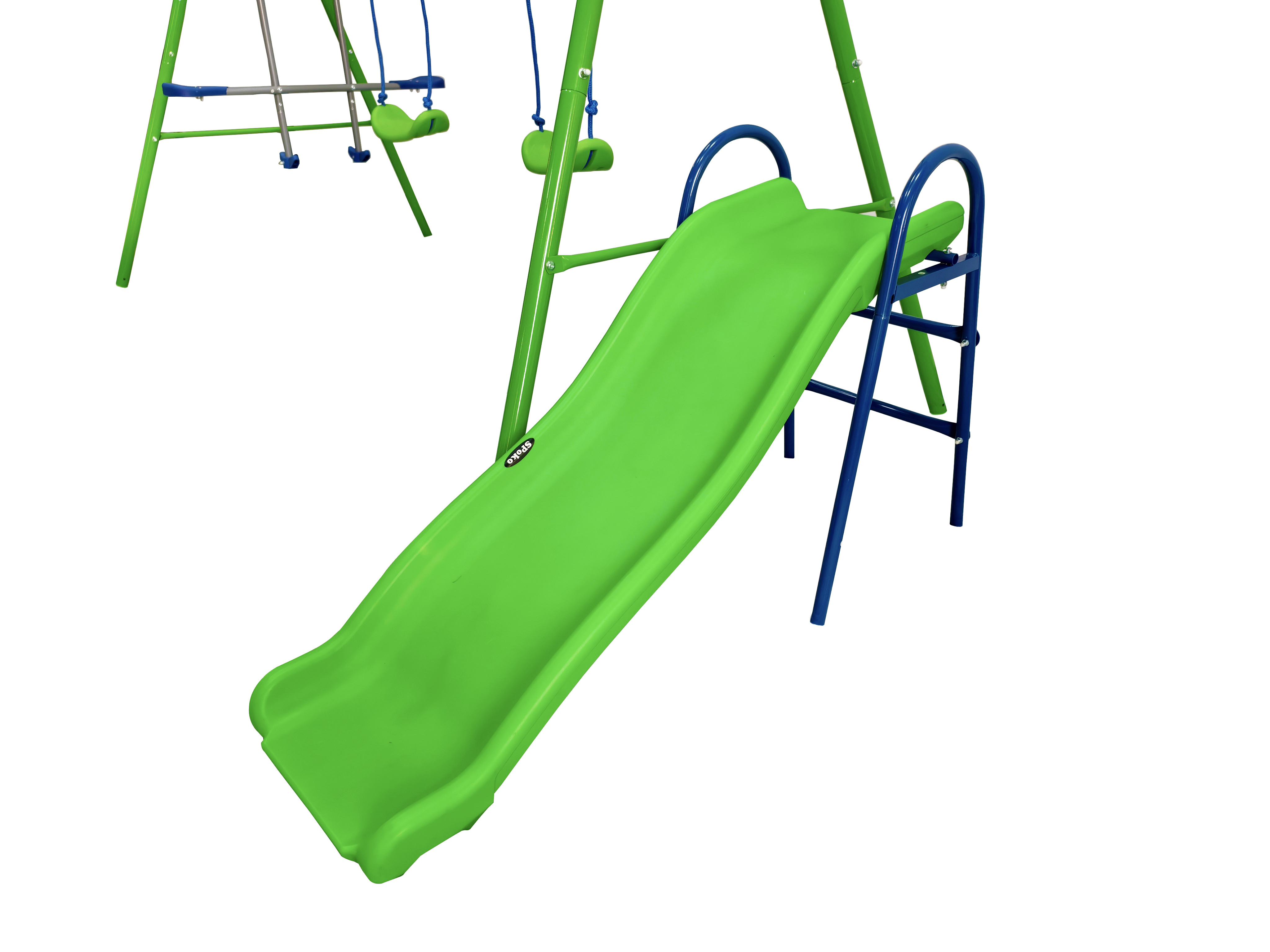
Customizing your outdoor slide and swing set ensures maximum engagement for your kids. You want features suitable for their current physical abilities and future growth spurts.
Deck height determines the overall challenge level of the play system. Choosing the right elevation prevents accidental falls while keeping activities engaging.
Toddlers (Ages 3-5): A 4-foot deck height provides safe, accessible fun. It allows parents to reach children easily if they need assistance.
School-age (Ages 6-10): A 5-foot deck height offers a moderate, exciting challenge. This height supports longer slides and taller climbing walls.
Pre-teens (Ages 10+): Look for 6-foot to 7-foot deck heights to keep older kids engaged. These taller structures accommodate spiral slides and complex vertical climbers.
Slide styles must match your chosen deck height and available ground space. Straight slides work exceptionally well for lower decks and simple landing zones. Wave slides add a thrilling bounce but require a slightly longer landing buffer to slow momentum. Tube slides fit perfectly on higher 5-foot to 7-foot decks. They enclose the child completely, adding a crucial layer of safety at higher elevations. Always check the landing zone clearance for any slide type before finalizing your layout.
Never assume all swing beams hold the same weight. You must verify the hardware load limits carefully. Basic metal S-hooks often bend or fail under adult weight. Look for heavy-duty ductile iron swing hangers instead. These robust, commercial-grade hangers accommodate older children and adults safely. Check the manufacturer's documentation to ensure the top beam itself can withstand heavy, dynamic swinging forces.
Children outgrow static toys at an astonishing rate. Prioritize scalability during your shopping phase. Identify systems designed specifically for easy modular upgrades down the road. You should be able to swap baby bucket swings for standard belt swings seamlessly. Look for expandable frames allowing you to attach monkey bars, rope ladders, or rock walls later. Modular designs prevent your expensive investment from becoming obsolete in just three years.
Your ground surfacing material provides the ultimate safety net against gravity. Many parents mistakenly believe a lush lawn offers adequate protection. It absolutely does not.
Natural turf fails miserably at providing adequate impact attenuation. Soil compacts tightly under heavy foot traffic and changing weather conditions. Once compacted, it completely loses its shock absorption capabilities. Grass cannot safely cushion falls from heights above 24 inches. You need specialized loose-fill or unitary materials to prevent serious head injuries.
EWF offers a highly cost-effective solution with excellent shock absorption. It blends seamlessly into natural landscape designs. However, it requires significant routine maintenance. Kids kick the mulch away from high-traffic zones like slide exits and swing paths. You must rake it level regularly. It also decomposes organically over time. You will need to top it off annually. Safety standards recommend maintaining a strict minimum 9-inch depth for optimal fall protection.
Recycled rubber mulch carries a much higher upfront cost. Yet, it proves extremely durable over a decade of use. It never decomposes and does not attract annoying wood-boring pests. You also need less volume overall. A typical 6-inch depth of rubber mulch offers the exact same fall rating as 9 inches of wood fiber. This makes it a brilliant long-term investment for busy families.
This option represents the premium commercial playground standard. It requires the highest initial financial outlay. You must hire specialized professionals for the chemical mixing and installation. The long-term benefits are massive, though. Poured-in-place rubber demands zero daily maintenance. It stays perfectly level, never displaces under swings, and offers maximum wheelchair accessibility.
Installing a massive outdoor swing slide set involves serious manual labor. Do not underestimate the preparation phase required before the delivery truck arrives.
The play structure itself often only consumes half your total project budget. You must prepare the site properly first. This frequently means hiring a skid steer to grade the yard to achieve a mathematically flat surface. You might need to excavate buried rocks or grind stubborn tree stumps. Furthermore, loose-fill surfaces require sturdy retaining borders. Installing heavy landscaping timbers or interlocking plastic borders keeps your expensive mulch contained safely inside the play zone.
A DIY approach saves hundreds of dollars but demands intense physical endurance. Let us do a quick reality check. Assembling a large playset typically takes 12 to 24 hours for two highly capable adults. You need specialized tools, including impact drivers, socket sets, and precise laser levels. Exact hardware sorting is absolutely necessary before you drive the first screw. Missing a single step in page four of the manual can ruin step forty.
Conversely, professional installation removes this massive burden entirely. Installers usually charge 20 to 30 percent of the set's retail price. They work efficiently, bring proper tools, and guarantee structural integrity. Always verify the installer’s liability insurance credentials. Ask about their specific workmanship warranty terms before signing a contract.
Gravity alone will not secure a tall swing set safely. You must anchor the frame firmly to the ground to prevent tipping. Standard auger-style ground stakes work fine for heavy wooden sets in protected, fenced yards. However, lighter metal frames need extra anchoring help. If you live in an area prone to high wind conditions, you need permanent concrete footings. Pouring small concrete footers around the main anchor points guarantees your set stays upright during severe thunderstorms.
Selecting the right play system requires a careful balance of competing priorities. You must align accurate spatial planning with your realistic maintenance expectations. Strict adherence to safety standards must guide every decision you make. Wood requires annual upkeep, while metal and vinyl offer compelling alternatives at different price points. Your yard’s topography ultimately determines your preparation workload.
Always start the buying process with a heavy-duty tape measure and a reliable level. Do this long before falling in love with a specific design or brand online. Knowing your exact yard dimensions prevents costly return shipping fees and frustrating assembly delays.
Take action today by evaluating your yard’s slope. Calculate your available safe use zone using the strict 6-foot rule. Finally, define your dedicated surfacing budget. Complete these essential steps before requesting installation quotes or browsing catalogs. Proper planning guarantees a safe, enduring play area that your children will cherish for years.
A: It depends heavily on your local municipality and neighborhood rules. Many Homeowner Associations (HOAs) enforce strict height restrictions. They often limit playsets to 8 or 10 feet tall. They also dictate specific property line setbacks. Always check local zoning laws and HOA bylaws before purchasing. Ignoring these rules can result in hefty fines or forced removal.
A: A high-quality wooden play structure typically lasts 10 to 15 years. This lifespan depends entirely on your maintenance routine. Premium woods like cedar resist decay naturally. However, you must stain and seal the wood every one to two years. Replacing worn swing belts and tightening hardware annually also extends the structure's usability.
A: Yes, you can relocate an existing playset, but it involves significant effort. Dismantling a wooden structure risks stripping lag bolts and splitting aging timber. Reassembly often weakens the overall structural integrity. Transporting large beams requires a specialized flatbed trailer. Often, the combined cost of professional dismantling and moving rivals the price of a new set.
A: Standard backyard swing belts typically support between 115 and 150 pounds per swing. This capacity easily accommodates toddlers and pre-teens. If you want older teenagers or adults to use the swings, you must upgrade. Look for commercial-grade belts and heavy-duty ductile iron hangers. These upgraded components safely support up to 250 pounds each.


