

close
Choose Your Site
Global
Social Media

Author: Site Editor Publish Time: 2026-06-24 Origin: Site
At the checkout stage, buyers face a tough choice. You must pick between the simplicity of a classic swinging structure and the multi-feature appeal of a combo playset. This decision impacts your daily backyard life. Making the wrong choice leads to frustrating problems. You might face dead grass. You might waste money. Your kids could quickly outgrow the equipment. A mismatched structure simply gathers dust. The right choice depends strictly on your available safety footprint. It also relies on your children's developmental stages. Finally, your appetite for assembly matters greatly. Are you considering a basic outdoor swing set for quick installation? Or do you want a slide and swing set to maximize play variety? We will break down exactly how to evaluate your space. You will learn how to match features to your family needs. We will help you build a safe, engaging environment.
Standalone swing sets are space-efficient, cost-effective, and ideal for older children or narrow yards.
A combo slide and swing set offers higher long-term engagement and supports varied motor skills but requires a significantly larger safety footprint.
Assembly time scales exponentially: a basic A-frame swing set takes a few hours, while a multi-feature slide combo often requires a full weekend or professional installation.
Total cost of ownership must factor in site preparation (leveling) and safety surfacing (mulch/mats), which increases with the size of the set.
Backyard play equipment generally falls into two distinct architectural categories. You must understand how these structures bear weight. You must also understand how they dictate play patterns. The fundamental design changes everything about installation and daily use.
This structure typically utilizes a classic A-frame design. It focuses purely on kinetic motion. Kids swing back and forth. It lacks a central deck. It does not include a climbing tower. Manufacturers design these frames for extreme stability along a single axis. You usually see them made from powder-coated steel or thick timber. The minimalist design keeps sightlines open across your lawn.
A combo playset acts as a busy activity hub. Builders design it around a central architectural element. This is usually a raised fort or a wooden tower. The tower serves as an anchor. It connects multiple play zones. Kids can slide, climb, and swing simultaneously. These structures encourage imaginative play alongside physical exertion. A slide and swing set transforms a basic yard into a multi-level playground.
These two designs carry very different engineering requirements. Combo sets require much sturdier anchoring systems. They feature heavy, off-center attachments like rock walls and wave slides. This off-center weight creates lateral torque. Manufacturers counteract this by using heavier materials. You will mostly find cedar or pressure-treated pine in these kits. The heavy wood absorbs the shifting forces. Standard A-frames distribute weight evenly down their legs. They tolerate slight ground imperfections much better than complex towers.
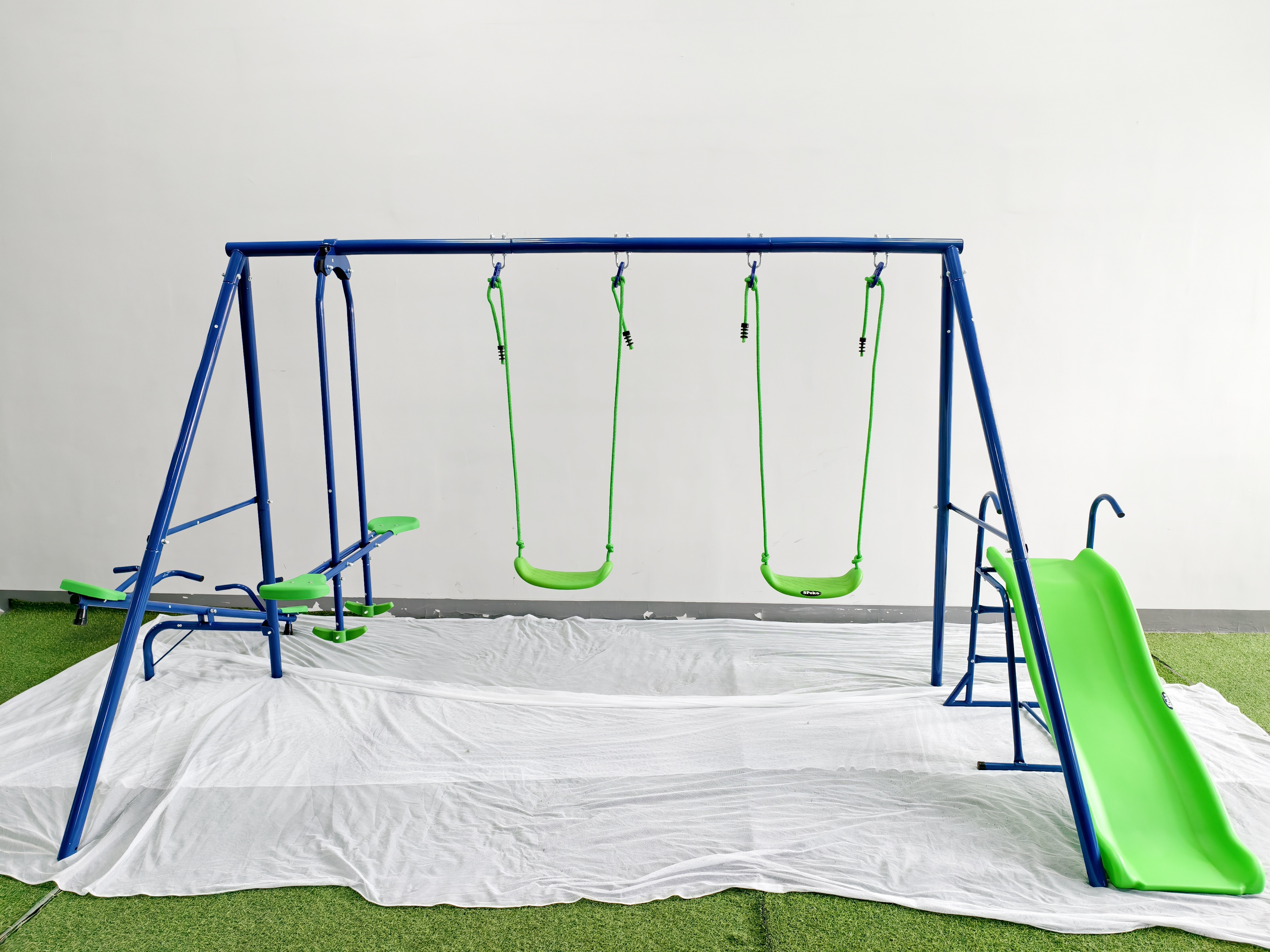
You cannot buy play equipment based on appearance alone. You must evaluate three strict parameters. Space dictates safety. Longevity dictates value. Proper budgeting prevents unpleasant surprises. Here is how you analyze your yard.
Safety zones define the absolute limits of your project. The Consumer Product Safety Commission (CPSC) recommends a strict "fall zone" metric. You need at least 6 feet of obstacle-free clearance in all directions around the equipment. This prevents collisions with fences, trees, or hard patios.
Linear Safety Zones: A basic outdoor swing set requires a linear clearance path. You must measure 6 feet in front of the maximum swing arc. You must measure 6 feet behind it. The sides need standard clearance.
Multi-Directional Safety Zones: Combo sets demand much more space. The slide exit requires extended clearance. Tower access points need dedicated pathways. You cannot overlap the swing path with the slide exit area.
Safety Zone Dimension Guide | ||
Component | Minimum Clearance Required | Reasoning |
|---|---|---|
Standard Swings | Twice the height of the swing beam (front and back) | Accommodates full swing arc and jumps |
Slide Exits | 6 feet minimum from the bottom lip | Prevents collisions upon landing |
Climbing Walls | 6 feet extending outward | Provides safe fall space for backwards slips |
Children develop fast. Their physical needs change dramatically between toddlerhood and middle school. You must match the equipment to their developmental horizon.
Toddlers to Early Elementary (Ages 3-7): These children highly benefit from multi-sensory play. They crave varied activities. A slide combo set builds gross motor skills. They practice gripping, stepping, and balancing. The enclosed forts offer spaces for imaginative role-play.
Late Elementary to Early Teens (Ages 8-12+): Older kids tend to outgrow small plastic slides quickly. Their legs get too long. The forts feel cramped. However, they continue to use heavy-duty swings for years. They use them for socialization and relaxation. A standalone frame often serves this age group better.
The sticker price only represents the beginning. You must budget for the entire installation ecosystem. Standalone frames cost significantly less upfront. They also cost less to install. Combo sets carry substantial hidden costs. You must buy increased volumes of safety surfacing. Wood chips or rubber mulch must cover the entire multi-directional footprint. Larger footprints require more cubic yards of mulch. You also face site preparation costs. We will cover those specific leveling requirements later.
Sometimes, simple designs work best. The classic A-frame remains popular for very good reasons. It delivers reliable entertainment without dominating your property.
These frames emphasize high kinetic engagement. Swinging stimulates the vestibular system. It helps children develop balance and spatial awareness. The minimalist design presents a major aesthetic advantage. It causes minimal visual obstruction in your backyard. You can still see your garden. You can still admire your landscaping.
These frames offer a much lower barrier to entry. DIY assembly is straightforward. Two adults can usually build one in a few hours. The parts list is short. The hardware is simple. Crucially, they require less intensive ground leveling. The basic A-frame can absorb minor dips in the lawn. You do not need laser-precise excavation.
The biggest drawback is the lack of variety. The structure only does one thing. This can lead to "play fatigue" faster. Younger children crave imaginative play. They want to climb. They want to hide in forts. A simple frame cannot provide those experiences. You might find younger kids abandoning it quickly.
This option perfectly suits specific buyers. You should buy this if you have a narrow suburban yard. It works well if your Homeowners Association enforces strict height restrictions. It serves as the best choice for parents buying primarily for older children. Older kids just want a place to hang out and swing high.
A combo playset serves as a backyard centerpiece. It brings the community park experience directly to your home. It offers incredible value, provided you have the space and patience for it.
Combo structures offer incredibly high play density. A single footprint entertains multiple children at once. One child can slide. Another can climb the rock wall. Two more can swing. They do all this without fighting over limited equipment. This dramatically reduces sibling conflict. It makes hosting playdates much easier.
These structures act as comprehensive physical development tools. They support a broad range of motor skills. Children practice bilateral coordination on the climbing wall. They build core strength on the monkey bars. They learn risk assessment while navigating the high deck. The variety keeps them physically challenged for years.
You must prepare for high assembly friction. Delivery day brings heavy boxes. You will face hundreds of hardware pieces. You will sort through dozens of wooden planks. Furthermore, combo sets strictly require perfectly level ground. The tower structure demands absolute vertical alignment. If the ground slopes, the joints will warp. The slide will sit crooked. The whole structure could become structurally unsound.
This option fits families with multiple children of varying ages. It suits buyers with larger backyards. You should choose this if you have the budget to hire professional installers. Alternatively, you need the patience to dedicate a full weekend to DIY assembly. You must enjoy large-scale home projects.
Comparison Chart: Feature vs Structure Type | ||
Feature/Metric | Standalone Swing Set | Combo Slide Playset |
|---|---|---|
Play Variety | Low (Kinetic only) | High (Kinetic, climbing, imaginative) |
Visual Impact | Minimal obstruction | High visual dominance |
Leveling Needs | Moderate tolerance for slopes | Strict requirement for flat ground |
Assembly Time | 2 to 4 hours | 12 to 24+ hours |
Best Age Group | 8 to 12+ years | 3 to 10 years |
Your journey does not end at checkout. Installation and ongoing maintenance dictate the lifespan of your investment. You must choose materials wisely. You must prepare your yard properly.
Material choices directly impact your annual maintenance routine. Standalone frames commonly use basic powder-coated metal. Metal requires very little upkeep. You simply check for rust spots. You touch them up with protective paint. You occasionally lubricate the swing hinges. It is generally a hands-off experience.
Combo sets usually feature cedar or treated pine. Wood demands annual attention. UV rays degrade the factory sealant. Rain introduces moisture. You must restain or reseal the wood every one to two years. Wood also naturally expands and contracts. This seasonal movement loosens bolts. You must perform annual hardware tightening. If you ignore this, the tower will wobble.
Many handy homeowners feel tempted to DIY a combo set completely from scratch. They want to buy raw lumber and design it themselves. We strongly advise against this. Pre-fab kits undergo rigorous safety testing. Engineers calculate the exact consumer safety weight limits. They pre-drill the holes to ensure joint integrity. Buying a pre-fab kit guarantees compliance with industry safety standards. Homemade structures often fail under dynamic weight loads.
You must complete realistic first steps before the delivery truck arrives. Proper site preparation prevents disaster.
Measuring Slope: Use a string line and a level. Check the grade of your chosen spot. If the drop exceeds a few inches, you have work to do.
Excavating: You may need to dig out the high side of the yard. Do not try to build up the low side with loose dirt. Loose dirt washes away under the heavy posts. Always dig down to solid, undisturbed soil.
Weed Barriers: Lay down professional-grade landscaping fabric. Do this before adding your protective mulch. This prevents grass and weeds from growing up through your expensive safety surfacing.
Choosing between a simple swinging frame and a complex play tower requires honest assessment. You must evaluate your property and your patience. Both structures offer fantastic benefits when matched to the right yard.
Summary Recommendation: Frame your final decision as a ratio. Weigh your "Available Space" against your "Desired Play Variety." If space is tight, keep it simple. If space allows, maximize the play density.
Focus on Longevity: Buy for the ages your kids will be, not just the ages they are today.
Respect the Groundwork: Never cut corners on ground leveling or safety surfacing.
Next-Step Action: Do not browse product catalogs yet. Grab a tape measure right now. Go physically measure your yard. Mark out the primary footprint. Then, add the mandatory 6-foot safety perimeter in every direction. Let those concrete numbers dictate your shopping list.
A: Generally, no. Retrofitting A-frames is often unsafe. Classic frames lack the central structural deck required to anchor a slide safely. They cannot support the off-center lateral torque generated by kids climbing and sliding. You risk tipping the entire structure. Always buy a purpose-built combo set if you want multi-feature play.
A: Standard safety measurements require a minimum of 6 feet of clearance at the slide exit. This zone must remain completely free of hard surfaces, fences, or other play equipment. This ensures a safe landing and provides room for a child to stand up and walk away without collisions.
A: A basic A-frame handles uneven ground better. Its simple legs offer slight tolerance for minor slopes. Complex slide and tower sets require perfectly level ground. If a tower sits on a slope, the wooden joints experience uneven stress, leading to dangerous warping and structural failure.
A: Yes. Combo sets use large amounts of wood and plastic. Wooden towers require annual checks for loose hardware, splintering, and rot. You must restain them regularly. Furthermore, plastic slides suffer from UV degradation over time. You must inspect them yearly for micro-cracks or fading.


