

close
Choose Your Site
Global
Social Media

Author: Site Editor Publish Time: 2026-05-01 Origin: Site
Installing an indoor swing is a high-stakes purchase for parents and occupational therapists alike. It requires you to balance developmental benefits closely against structural home safety. A beautiful design catches the eye quickly. Yet, your final choice hinges on crucial functional details. You must deeply evaluate specific sensory outcomes, structural load-bearing limits, and rigid installation constraints. Some kids need a calming retreat, while others crave intense physical stimulation. This guide deliberately bypasses superficial marketing claims. We provide a strict, evidence-based evaluation framework. We will help you select a safe, developmentally appropriate swing. You will learn exactly how to integrate this equipment into your existing home infrastructure without compromising safety.
Hardware dictates safety: A swing’s weight limit is irrelevant if the ceiling joist or mounting hardware cannot support dynamic load (the force of a swinging child).
Sensory mapping is critical: Match the swing design (e.g., cocoon vs. platform) to the child’s specific vestibular or proprioceptive needs.
Material matters: Fabric choice (nylon vs. cotton canvas) impacts both tactile feedback and long-term maintenance.
Installation dictates design: Single-point and double-point mounts require entirely different ceiling clearance zones.
Every successful installation starts by defining clear functional goals. You cannot buy suspended equipment just because it looks fun. You need to establish a strict baseline of success before drilling into your ceiling. A reliable evaluation framework relies on three foundational pillars.
Identify the Core Use Case: You must explicitly categorize the primary purpose of the equipment. Does the child need recreational play, sensory regulation, or active motor-skill development? Calming tools differ wildly from active playtime tools. You want deep pressure for calming down. Conversely, you want unstable bases for building core strength.
Understand Dynamic Weight Limits: Static weight ratings deceive many buyers. Static weight measures the equipment resting completely still. Dynamic weight accounts for the intense kinetic force applied during active use. A child bouncing or spinning forcefully multiplies their actual body weight significantly. Always evaluate the dynamic capacity of your entire setup.
Home Infrastructure Assessment: Your house ultimately decides what you can safely install. Ceiling type disqualifies certain models instantly. Standard drywall simply cannot hold suspended dynamic loads. You absolutely must locate solid structural wooden joists or exposed concrete beams. Alternatively, you might need a freestanding load-bearing frame.
Different shapes deliver unique neurological feedback. Occupational therapists refer to this alignment as sensory mapping. You must match the equipment design directly to a child’s specific vestibular or proprioceptive needs. A high-quality Fabric Swing often acts as the most effective tool in your sensory regulation toolkit.
This design utilizes high-stretch materials. It wraps tightly around the user’s body. The mechanism provides deep, comforting pressure alongside continuous proprioceptive feedback. It acts like a giant, suspended hug. This variation works best for overstimulated children. They often require a calming, completely enclosed environment to process sensory overload effectively.
Pod designs feature a distinctive teardrop shape. They usually contain a structured, inflatable cushion at the base. The mechanism offers a semi-enclosed visual boundary. It blocks out chaotic room sights. It creates an ideal quiet reading nook. Many parents find this shape perfect for crafting a low-stimulation retreat inside a busy household.
Hammocks feature an open, wide design. They typically utilize double-point mounting systems above. This mechanism allows for gentle, highly predictable linear rocking. You cannot spin wildly in a hammock. This style remains best for broad recreational use. Siblings share them easily. Furthermore, hammocks integrate cleanly alongside modern home aesthetics.
Swing Type | Primary Mechanism | Ideal Sensory Outcome | Target User Profile |
|---|---|---|---|
Stretchy Cocoon | Full body wrapping | Deep pressure (Proprioceptive) | Overstimulated, seeking tight compression |
Pod-Shaped | Inflatable base, semi-enclosed walls | Visual boundary restriction | Seeking quiet isolation, readers |
Hammock-Style | Double-point linear movement | Gentle rhythmic rocking | Broad recreation, mild vestibular input |
Fabric choice directly influences daily maintenance and tactile comfort. Do not compromise on material integrity. Furthermore, inferior hardware introduces severe safety hazards into your home.
Cotton canvas offers a highly breathable surface. It looks incredibly aesthetically pleasing in most living rooms. It feels natural against bare skin. However, cotton canvas remains highly prone to shrinkage after washing. It also requires strict indoor humidity control to prevent insidious mold growth.
Nylon and spandex blends offer different advantages. They boast extremely high tensile strength. They remain highly wear-resistant under heavy daily friction. These synthetic blends act as the ideal choice for deep sensory wrapping. However, synthetic textures trap heat quickly. They may also irritate highly tactile-sensitive children.
Never rely strictly on anonymous brand promises. Look for verifiable safety benchmarks regarding toxicity and structural limits. Check for OEKO-TEX® certification. This standard guarantees the textiles remain completely free of harmful chemicals. For the mounting hardware, you should demand clear ASTM or EN71 compliance. These international standards prove the manufacturer tested the metal components under extreme stress.
Your hardware chain matters equally as much as your textile choice. Standard household hardware fails under dynamic swinging forces. You must use industrial or climbing-grade components. Carabiners should feature locking gates. Swivel hooks remain mandatory for any rotational devices. Swivels prevent ropes from twisting dangerously. Heavy-duty ceiling anchors must bolt securely into thick structural wood.
Component | Requirement Standard | Safety Function |
|---|---|---|
Carabiner | Climbing-grade (e.g., 25kN rating) | Prevents accidental detachment during bouncing. |
Swivel Hook | Industrial rotational bearing | Prevents fabric twisting and hardware snapping. |
Ceiling Anchor | Multi-bolt heavy-duty steel plate | Distributes kinetic force across the wooden joist. |
Even the safest equipment poses risks inside cramped spaces. Your home layout dictates your ultimate installation strategy. Planning the exact physical footprint prevents accidents.
You must outline a strict mathematical formula for calculating required space. You cannot guess clearance zones. Always measure twice. Follow these non-negotiable spacing rules:
Maintain a minimum of 3 to 6 feet of clearance from all nearby walls.
Ensure the swing path avoids glass windows entirely.
Remove hard furniture from the immediate drop zone.
Place a thick crash mat directly underneath the equipment.
Your ceiling anchor points dictate how the equipment behaves in motion. Single-point mounts allow for chaotic, 360-degree rotation. This setup requires a dedicated, frictionless swivel. Without a swivel, the fabric twists violently. Twisted fabric eventually snaps the ceiling hardware.
Double-point mounts space two anchors apart on the ceiling. They strictly restrict movement to linear swinging. You can only travel forward and backward. This limitation significantly reduces the risk of vestibular overload. It prevents children from spinning themselves into severe nausea.
We strictly advise against DIY drywall anchor installations. Drywall possesses zero structural integrity. Toggle bolts pull straight through plaster under dynamic load. Highlight the absolute necessity of anchoring directly into solid ceiling joists. If your ceiling lacks accessible joists, you must purchase a freestanding load-bearing frame instead.
Families often desire maximum utility from their therapeutic investments. You might want to move the equipment outside during pleasant weather. However, transitioning between environments introduces new structural challenges.
Evaluate carefully when you can temporarily relocate an indoor setup. You might hang it from a sturdy patio beam. You might string it over a thick tree branch. Temporary usage outdoors remains generally safe on dry, sunny afternoons. Always inspect the tree branch for rot before suspending any weight.
Explain clearly why prolonged outdoor exposure ruins standard indoor fabrics. Sunlight acts as a relentless destroyer of synthetic textiles. UV damage rapidly compromises nylon tensile strength. The fabric becomes brittle and dangerous. Furthermore, atmospheric moisture breeds toxic mold deep inside cotton fibers. Standard indoor equipment simply cannot survive overnight dew.
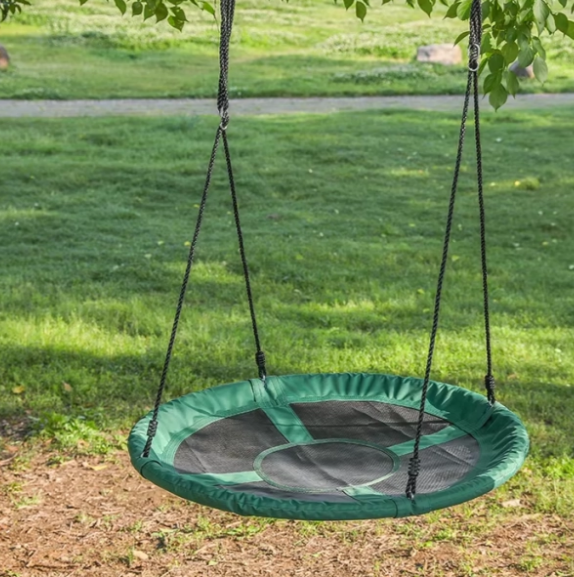
If an Outdoor Fabric Swing is your primary goal, you must alter your purchasing criteria entirely. Indoor models will fail. You need specialized, heavy-duty weather-resistant polyesters. Oxford cloth stands out as an excellent choice against harsh weather. You also require rust-proof stainless-steel hardware. Zinc-plated indoor bolts rust quickly when exposed to morning rain. Prioritize outdoor-specific ratings to ensure lasting safety in your backyard.
Purchasing suspended indoor equipment demands careful planning and rigorous structural awareness. You are ultimately building a miniature playground directly inside your living room. The success of this project requires aligning the child's sensory profile perfectly with the home's structural realities.
We recommend specific next steps for all prospective buyers. First, measure your ceiling height and calculate your clearance zones accurately. Second, locate your structural wooden joists using a reliable stud finder. Finally, consult directly with an occupational therapist if you are purchasing equipment for targeted sensory processing support. They can guide your material and shape choices optimally.
A: Most commercial fabrics are rated for 150-200 lbs, but the true bottleneck is the ceiling anchor. Always defer to the lowest weight rating in your hardware chain. A weak carabiner completely negates a strong textile rating.
A: Yes. Rapid rotation can overload the vestibular system. Unregulated spinning should be limited, and a professional swivel hardware attachment is required to prevent unpredictable recoil. Always monitor children closely during intense rotational sessions.
A: If you are unsure how to locate the exact center of a structural ceiling joist, hiring a licensed contractor or a specialized installer is heavily recommended to mitigate safety and liability risks. Guessing joist locations causes catastrophic ceiling failures.


