

close
Choose Your Site
Global
Social Media

Author: Site Editor Publish Time: 2026-06-30 Origin: Site
Parents evaluating backyard play structures often face a stark gap between sunny marketing claims and harsh implementation realities. Manufacturers quickly promise endless hours of fun. However, families frequently encounter wobbly frames, rapidly rotting wood, or badly rusting metal after just one harsh winter. Purchasing a play set stands as a major multi-year investment for your home. A poorly constructed set risks serious child injury and forces premature replacement. Conversely, a rigorously tested structure offers crucial physical developmental benefits and profound peace of mind. We created this comprehensive guide to help you cut through endless sales fluff. It provides a strict, evidence-based evaluation framework for concerned parents. You will learn how to identify a structurally sound, fully compliant, and truly durable backyard play system. We thoroughly examine material science, stringent safety standards, and proper installation techniques. You will quickly master the exact requirements needed to protect your children during active outdoor play.
Material composition dictates lifespan: Prioritize rot-resistant cedar, high-gauge steel, and UV-stabilized plastics over standard untreated lumber or thin tubular metals.
Compliance is measurable: Safe sets adhere strictly to CPSC (Consumer Product Safety Commission) guidelines for fall zones, guardrail heights, and hardware safety.
Surfacing matters as much as the structure: Over 70% of playground injuries involve falls; planning for impact-attenuating surfacing (not just lawn grass) is a mandatory step in backyard installation.
Look for scalability: The best sets adapt to a child’s growth through modular swing attachments and appropriate deck heights.
Many homeowners struggle to distinguish between temporary seasonal toys and durable backyard infrastructure. Big-box retailers heavily market lightweight plastic and thin metal frames. These options look highly appealing in store displays. Yet, they rarely withstand the aggressive physical demands of growing children or severe weather conditions. Buying a cheap structure introduces hidden long-term problems. You will likely face frequent repairs, unexpected safety hazards, and early disposal requirements.
Budget sets often rely on lightweight materials and proprietary, non-replaceable hardware. If a specialized bolt snaps, you cannot easily find a replacement at a local hardware store. The entire structure compromises itself. Joints loosen over time. Structural wobbling increases exponentially. The frame eventually becomes unstable during routine swinging motions.
You must define strict success criteria before shopping. A successful investment means finding an outdoor slide and swing set designed to support active use for five to ten years minimum. It should require minimal structural maintenance. It must maintain strict safety tolerances through extreme heat, heavy rain, and freezing temperatures. True backyard infrastructure stands firm regardless of the season. It provides a safe, reliable play environment day after day.
The core framework dictates how long your play system will survive outdoor exposure. Buyers generally choose between wood and metal structures. Each material demands specific quality checks to ensure long-term durability and safety.
When evaluating wood frameworks, you must inspect the lumber grades carefully. Untreated pine absorbs moisture quickly, causing severe splitting and warping. Instead, look for factory-stained, rot-resistant wood. Premium cedar naturally repels pests and resists rot due to its natural oils. Cedar frames maintain their structural integrity far longer than cheaper alternatives.
If you prefer steel structures, material thickness becomes paramount. When evaluating a metal swing set, demand high-gauge steel. The metal must undergo both galvanization and powder coating. Galvanization prevents internal rust from forming. Powder coating seals the exterior against moisture, chips, and UV damage. Avoid thin tubular metals. They bend easily under dynamic weight loads.
Hardware and connectors also require close inspection. Insist on commercial-grade, rust-resistant hardware. Manufacturers must recess or cap nuts and bolts. Exposed bolt threads present a severe laceration hazard. They also create entanglement risks for clothing drawstrings.
Slide plastics must handle intense sun exposure. Look for high-density polyethylene (HDPE). Manufacturers must inject UV inhibitors directly into the plastic. These inhibitors prevent the material from becoming brittle or cracking. High-quality HDPE also reduces excessive heat retention during peak summer months, protecting bare skin from burns.
Material Type | Durability Indicators | Common Weaknesses to Avoid | Maintenance Requirements |
|---|---|---|---|
Premium Wood (Cedar) | Factory-stained, thick-cut beams, natural rot resistance | Untreated pine, thin dimensional lumber, excessive knots | Annual sealant application, occasional tightening |
Heavy-Duty Metal | High-gauge steel, galvanized, powder-coated finish | Thin tubular aluminum, painted-only steel, exposed welds | Periodic rust spot checks, touch-up painting |
Plastics (Slides/Roofs) | HDPE composition, molded UV inhibitors, double-wall construction | Single-wall brittle plastics, dark colors absorbing heat | Routine cleaning, inspecting for surface cracks |
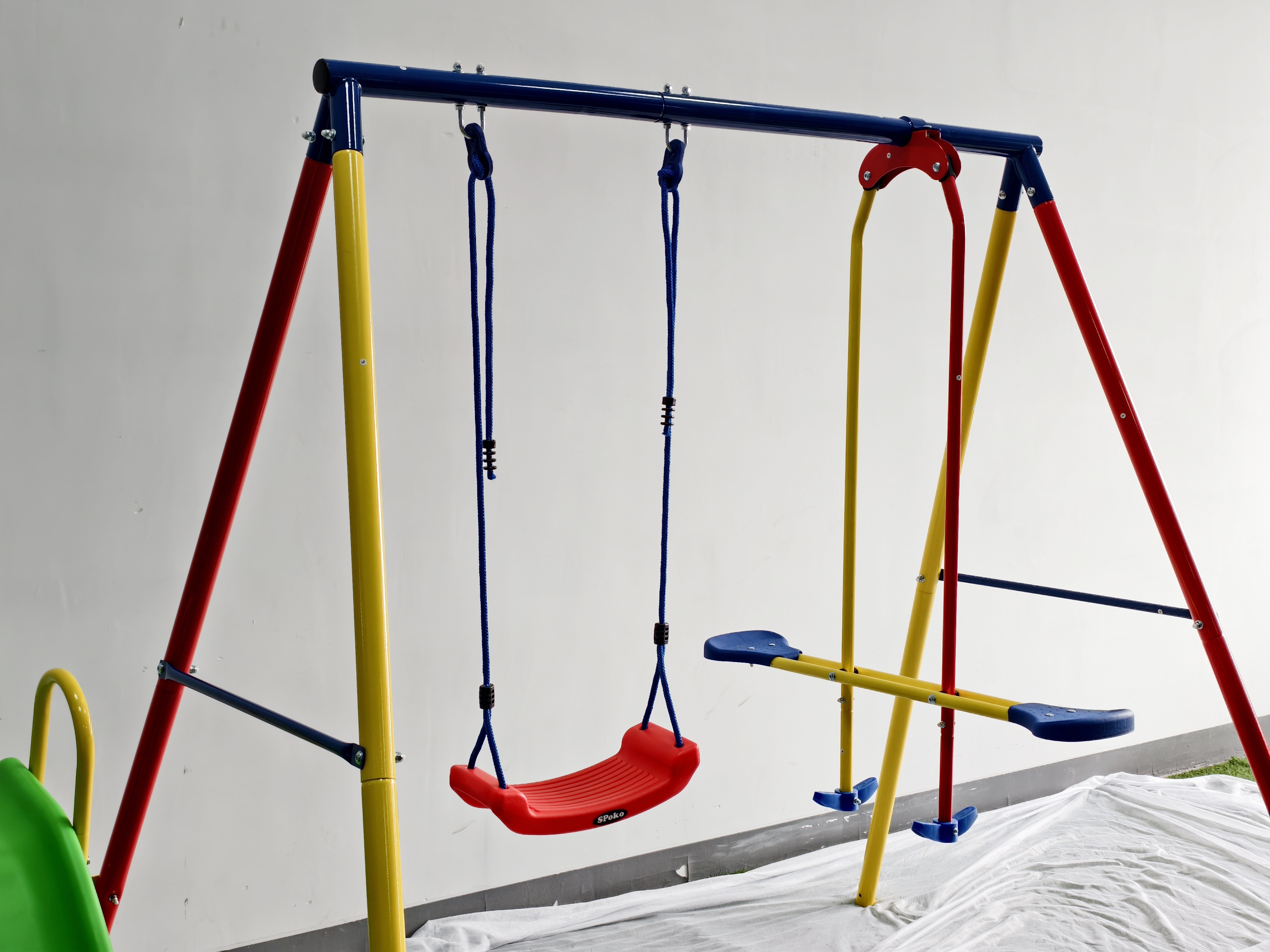
Safety claims require concrete proof. You should aggressively avoid products advertising vague "child limits" or "multi-kid capacities" without providing exact figures. Look for transparent per-user weight capacities. Demand total-structure weight limits verified by independent testing laboratories. A well-engineered set confidently publishes these metrics.
Structural anchoring requires zero compromises. Ground anchors are not optional accessories. They serve as critical safety components. A secure set must include a heavy-duty anchoring system. Heavy swinging generates immense momentum. Without anchors, the entire A-frame can lift, shift, or tip over completely. Manufacturers should supply auger-style ground anchors designed to bite deeply into compact soil.
Pinch-point and spacing safety directly impact your child's well-being. You must evaluate the design for CPSC compliance. Specifically, measure the spacing between ladder rungs and balcony rails. CPSC guidelines dictate gaps must measure less than 3.5 inches or greater than 9 inches. This exact measurement prevents head and neck entrapment. A child's torso might slip through a gap, but their head could become trapped if the spacing violates these strict rules.
Elevated platforms demand protective barriers. Any deck elevated above the ground must feature sturdy, high-profile guardrails. The guardrails need minimal vertical gaps. They must sit high enough to prevent a top-heavy toddler from accidentally falling backward over the edge.
Children grow rapidly. Their physical capabilities change drastically between the ages of two and ten. A rigid play structure quickly becomes obsolete. The best investments adapt seamlessly to your child's developmental stages.
You must match specific play features to your child's current age. Consider the following developmental milestones when configuring your yard:
Toddlers (Ages 2-5): Toddlers lack advanced grip strength and balance. They require high-backed bucket swings to remain secure. They need enclosed step ladders rather than open rungs. Slide platforms should remain under four feet tall. Shorter slides reduce intimidation and minimize fall height risks.
School-Age (Ages 6-12): Older kids demand challenging physical activities. They outgrow bucket swings quickly. They prefer flexible belt swings, trapeze bars, and challenging rock-climbing walls. They thrive on higher decks reaching five feet or more, which accommodate longer, faster slides.
Modular upgradability separates premium systems from disposable toys. Highly rated play systems offer interchangeable components. You should assess whether you can easily swap a baby bucket swing for a standard belt swing later. Consider whether the main beam supports heavier glider attachments. Scalable designs ensure your family utilizes the equipment heavily for a decade, rather than abandoning it after three years.
Purchasing the right equipment represents only half the safety equation. How you install the equipment in your yard matters equally. Poor installation environments routinely compromise premium engineering.
Calculating the "Use Zone" prevents catastrophic collisions. Safety requires a minimum six-foot clearance obstacle-free zone in all directions around the equipment. You cannot place a playset directly against a fence or under low tree branches. Swings require even more extended clearance. You must measure twice the height of the swing pivot point to determine the safe distance in front of and behind the swing paths.
You must realistically assess DIY versus professional assembly. Acknowledge the sheer complexity of the assembly process. Modern playsets contain hundreds of heavy wooden beams and complex hardware bags. Improperly torqued bolts weaken the frame. Unlevel ground compromises the entire structure, putting severe stress on specific joints. If your yard slopes heavily, or if you lack specialized power tools, hiring professional installers becomes a mandatory safety step.
Impact-attenuating surfacing requires serious budget consideration. Parents often wrongly assume backyard lawn grass provides adequate fall protection. Grass and dirt quickly lose all shock absorption once packed down by foot traffic. CPSC statistics show over 70% of playground injuries involve falls to the surface. You must factor in the cost and installation of proper surfacing materials. Options include engineered wood fiber, heavy rubber mulch, or poured-in-place rubber. You need to maintain these loose-fill materials at a minimum depth of nine to twelve inches to protect against head injuries.
Navigating the crowded market requires a systematic approach. Do not rely on promotional photos. Instead, use a strict buyer's checklist to vet potential slide and swing sets before opening your wallet.
Demand transparency in warranties: Read the fine print carefully. Look for 10-year or lifetime warranties on major structural components. A 1-year limited warranty signals cheap manufacturing.
Verify safety compliance: Confirm the manufacturer strictly adheres to ASTM and CPSC standards. They should openly publish their testing methodology.
Audit your backyard dimensions: Measure your available space against the required Use Zone. Do not measure against just the product's physical footprint. Ensure you have room for the necessary fall surfacing borders.
You must also identify critical red flags. Avoid brands failing to include heavy-duty anchor kits in the base package. Watch out for mixed metal types in the hardware. Combining dissimilar metals outdoors causes rapid galvanic corrosion, destroying the bolts from the inside out. Finally, reject brands lacking accessible, domestic customer service. You will eventually need replacement parts, and poor support renders the equipment useless.
Take immediate next steps today. Measure your yard precisely. Determine your primary material preference based on your climate. Finally, consult with a playground equipment specialist. They can help you match a specific configuration to your family's unique developmental needs and budget constraints.
True playground safety goes far beyond vigilant parental supervision. Real safety lives inside the engineering, the material science, and the installation environment of the equipment itself. Cutting corners on structural integrity or surface preparation introduces unacceptable risks to your family. By demanding premium rot-resistant wood, high-gauge steel, and strict CPSC compliance, you protect your children from severe injury.
Investing in high-quality materials and rigorous compliance entirely eliminates the anxiety of backyard play. You can relax knowing the frame will hold firm, the hardware will not rust, and the guardrails will protect them. The initial upfront investment repays you through a decade of maintenance-free, worry-free outdoor activity.
Do not settle for temporary seasonal toys. Browse our collection of CPSC-compliant, heavy-duty play structures today. Contact our support team for a free backyard space consultation. We will help you find the perfect, scalable fit for your growing family.
A: A premium structure should last 10 to 15 years, and often longer, with proper maintenance. The exact lifespan depends heavily on your chosen material. High-grade cedar, redwood, or heavily galvanized steel withstand weather exceptionally well. Routine maintenance, such as annual wood sealing and tightening hardware, significantly extends the life of the equipment regardless of your local climate conditions.
A: Both materials offer exceptional safety if constructed with premium components. Metal provides a lower-maintenance experience and completely eliminates splinter risks. Treated wood offers massive structural weight, resisting tipping, and delivers a classic aesthetic. Ultimately, safety relies entirely on the steel's gauge thickness, rust-proofing treatments, and the quality of the ground anchoring system used during installation.
A: The safest materials include heavy rubber mulch, engineered wood fiber (play-grade wood chips), or poured-in-place rubber surfacing. Standard lawn grass offers virtually zero impact attenuation. You must maintain loose-fill materials at a depth recommended by CPSC guidelines. Usually, this requires 9 to 12 inches of depth, depending on the maximum fall height of your highest deck.
A: Yes. Installing heavy play equipment on unlevel ground places severe stress on the structural joints. It immediately compromises the ground anchor system. It also creates extreme tipping hazards during swinging. You must perform minor yard grading and soil leveling before installation. A level foundation guarantees the physics of the swings operate safely and symmetrically.


