

close
Choose Your Site
Global
Social Media

Author: Site Editor Publish Time: 2026-07-01 Origin: Site
You have moved past the initial idea of building a backyard playground. Now, you face the practical reality of evaluating space, time, and budget. Framing this purchase requires looking beyond mere entertainment. A well-designed backyard structure serves as functional developmental infrastructure. It actively shifts children away from screen-based habits. Instead, they engage in healthy, independent play right at home.
Our objective is to provide you a clear, actionable evaluation framework. You will learn how to select a durable, age-appropriate playset. We will guide you toward finding long-term value. You can achieve this without facing hidden installation hurdles or unexpected maintenance surprises. By understanding materials, spatial requirements, and component scalability, you ensure your yard becomes a safe, engaging environment.
A quality outdoor slide and swing set delivers measurable lifestyle ROI by promoting physical development, independent outdoor play, and family engagement.
Evaluating playsets requires looking beyond aesthetics to assess material durability, weight capacities, and maintenance realities (wood vs. vinyl vs. metal).
Selecting scalable features—like modular swing beams and advanced climbing components—ensures the structure remains engaging as children age.
Proper site preparation, including leveling and establishing safety clearance zones, is a non-negotiable step before finalizing any purchase.
Consistent access to backyard play structures significantly accelerates early childhood development. Climbing, swinging, and sliding directly support gross motor skills. When kids navigate a wobbly bridge or scale a rock wall, they build core strength. They also refine their balance and spatial awareness. Swinging stimulates the vestibular system, which helps children understand body position. Mastering these physical challenges builds profound cognitive confidence. Kids learn to assess risk, coordinate complex movements, and problem-solve in real-time.
Parents constantly battle indoor digital consumption. A backyard playset acts as a friction-free, immediate alternative. Kids do not need apps, passwords, or parental setup to use a slide. The structure stands ready at all times. This encourages daily unstructured play. Unstructured play requires children to invent their own games and narratives. They step away from passive consumption and become active creators of their own physical experiences. Over time, the playset becomes the default destination for afternoon energy burning.
Adding a sturdy playset transforms a passive landscape into a primary family gathering space. You stop driving to crowded public parks. Your backyard becomes the neighborhood hub for playdates and weekend activity. Furthermore, well-maintained wooden or vinyl structures positively impact property aesthetics. When you eventually sell your home, an attractive playset appeals strongly to future buyers. Families often view existing, high-quality outdoor play equipment as a major property bonus.
Slides dictate a large portion of your spatial layout. Wave slides offer a traditional, fast ride but require a long, straight run-out zone. You must account for this horizontal footprint. Tube slides enclose the rider, offering a thrilling, tunnel-like experience. However, dark plastic tubes retain heat in direct summer sun. Spiral slides provide an excellent space-saving solution. They wrap tightly around the main fort, maximizing vertical utility. Consider your yard dimensions and prevailing sunlight before finalizing a slide style.
The swing beam acts as the anchor of the entire system. Evaluate beam height carefully. A taller beam provides a wider, more exciting swing arc for older kids. Check the hardware quality at the pivot points. Heavy-duty, commercial-grade hangers prevent squeaking and wear. Standard belt seats work well for older children. However, upgrading to specialized accessories significantly expands usability. Swapping a basic seat for a dynamic outdoor playground swing like a web or nest swing allows multiple kids to ride together.
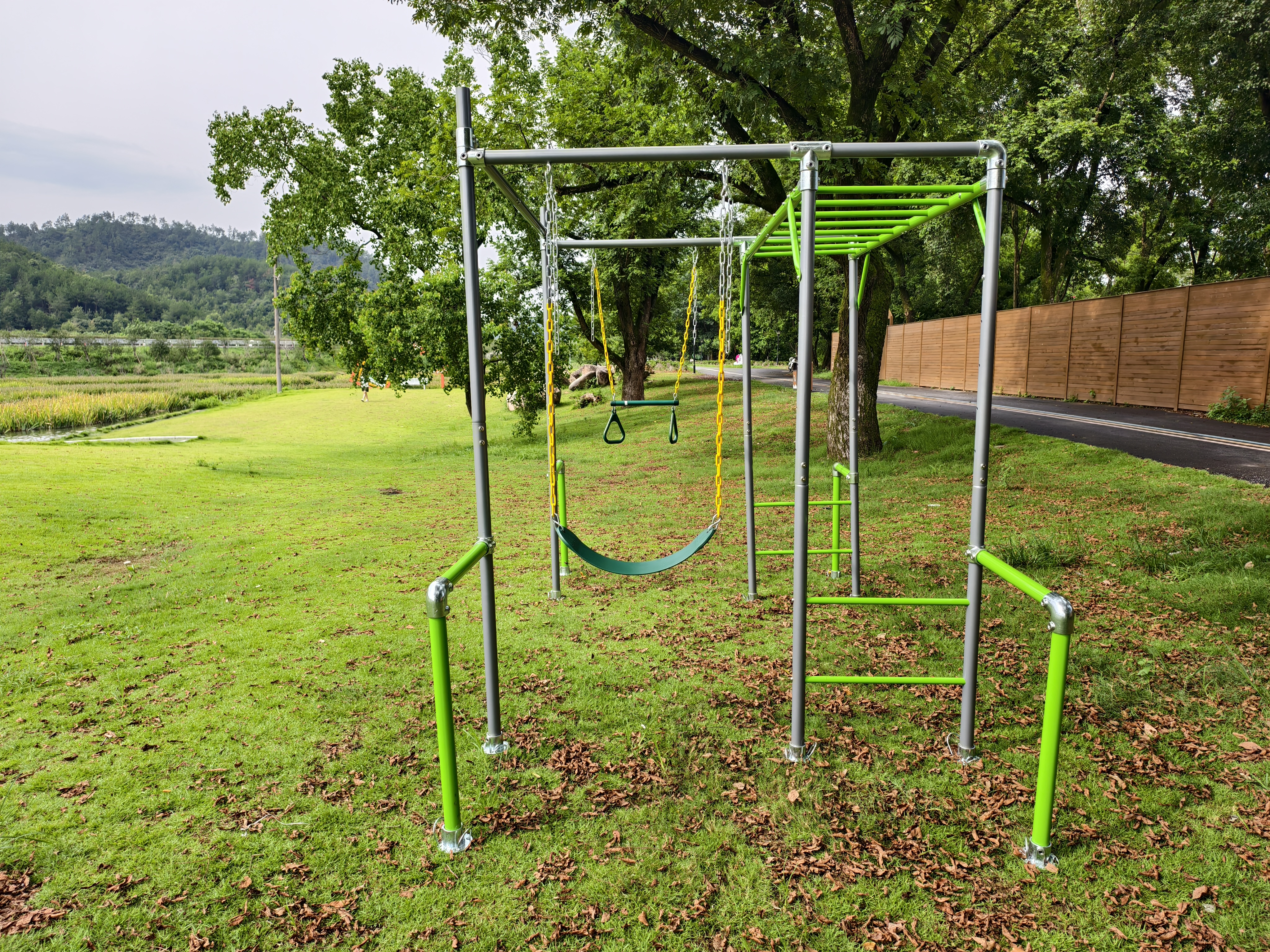
Basic swings and slides eventually lose their appeal as kids grow stronger. Adding advanced agility features bridges the gap between early childhood play and pre-teen athletic challenges. Integrating a swing set monkey bar provides excellent upper-body conditioning. Rock climbing walls and heavy-duty rope ladders offer similar benefits. These components challenge older kids to build grip strength and coordination. They keep the playground relevant long after the toddler years end.
The central tower, or clubhouse, anchors the imaginative play experience. Assess the upper and lower deck configurations. Deck height serves as a primary indicator of longevity. A low 4-foot deck feels safe for toddlers but quickly becomes cramped. A 5-foot or 6-foot deck ensures older children can stand comfortably inside. Look for sturdy canopies or wooden roofs. These protect kids from UV rays and sudden rain showers, extending daily playtime.
Safety remains the absolute priority for toddlers and preschoolers. Focus your design on safety enclosures and guardrails. Lower deck heights, typically around 4 feet, reduce fall risks. Enclosed tube slides prevent accidental tumbles over the edge. Bucket swings offer essential back and torso support for tiny riders. Keep climbing angles gentle. Incorporate solid step ladders rather than wide-gap rope nets.
Children in this bracket possess boundless energy and growing coordination. They need higher decks ranging from 5 to 6 feet. Longer wave slides provide the speed they crave. You can introduce standard belt swings, allowing them to pump their legs independently. Moderate climbing walls replace simple ladders. This age group loves imaginative scenarios. Forts featuring steering wheels, telescopes, and built-in picnic tables see heavy daily use.
Pre-teens test the physical limits of any structure. Weight capacity requirements become critical. Focus on high-clearance swing beams to accommodate their taller frames. Challenging overhead features become necessary. A robust swing set monkey bar configuration tests their developing athleticism. Heavy-duty structural joints must withstand intense swinging and jumping. At this stage, the playset acts more like a backyard gym than a simple toy.
Children outgrow restrictive toys quickly. We strongly recommend buying a size up. Frame this decision as an investment in a modular system. You want a structure accommodating future upgrades. You might start with bucket swings and a basic slide. Later, you can swap in a trapeze bar or a challenging climbing net. Choosing scalable architecture ensures the equipment matches your child’s expanding physical capabilities over the next decade.
Selecting the right material determines your future maintenance schedule. Each option balances aesthetics, durability, and upkeep demands.
Material Type | Characteristics & Upkeep | Pros | Cons |
|---|---|---|---|
Cedar / Redwood | Requires bi-annual sealing or staining. Prone to minor checking (natural wood cracking). | Classic aesthetic, naturally rot-resistant, stays cool in the sun. | High maintenance, potential for future splinters if neglected. |
Vinyl-Clad Wood | Wood core covered in a thick PVC sleeve. Needs only occasional power washing. | Lowest maintenance, absolutely no splinters, structural strength of wood. | Higher upfront purchase price, limited color options. |
Powder-Coated Metal | Galvanized steel with a baked-on protective finish. Needs rust checks. | Extreme durability, handles heavy weight loads easily. | Retains heat in direct sunlight, scratches can lead to rust. |
Never compromise on hardware grading. Check manufacturer specifications for ASTM safety compliance. ASTM sets rigorous standards for residential and commercial playground equipment. Inspect the design for recessed hardware. Exposed bolt threads snag clothing and cause nasty scrapes. Ensure all swing hangers utilize commercial-grade steel and locking carabiners. Good hardware keeps the structural joints rigid, preventing dangerous swaying during active play.
Provide yourself a realistic look at ownership. Playsets are not "set it and forget it" products. You must torque-check all bolts seasonally. Wood expands and contracts, which loosens critical joints over time. Check wooden components for early signs of rot, especially near ground contact points. If you live in a harsh climate, winterize your setup. Remove plastic swings, canvas canopies, and fabric accessories before heavy snow hits.
Safety starts before you build. You must establish a strict safety perimeter around the entire structure. The standard rule dictates a 6-foot clearance zone in all directions beyond the physical dimensions of the outdoor slide and swing set. If the slide extends 10 feet, the safe use zone extends 16 feet. Keep this perimeter clear of fences, overhanging tree branches, retaining walls, and utility lines. Ignoring clearance zones drastically increases injury risks during falls.
Playsets cannot sit safely on uneven ground. A sloped yard places immense stress on structural joints, causing premature failure. You may need to hire a landscaper to grade the site perfectly flat. Once level, evaluate impact-absorbing ground covers.
Rubber Mulch: Offers the highest shock absorption. It does not compress easily and drains water quickly.
Engineered Wood Fiber: Provides a natural look. It knits together to create a firm, wheelchair-accessible surface but requires regular top-offs.
Pea Gravel: Inexpensive and drains well. However, it easily spills into grass and poses a choking hazard for toddlers.
Assembling a premium playground is a massive undertaking. Provide yourself a realistic time-cost analysis. A complex set often takes two capable adults between 15 and 20 hours to assemble. You must interpret hundreds of steps and sort thousands of hardware pieces. One upside-down panel can cost hours of rework. Acknowledging this reality makes professional installation a highly viable add-on. Factoring installation into your final budget saves intense frustration and guarantees structural integrity.
Evaluating backyard play equipment requires balancing immediate fun with long-term utility. Follow a structured approach to make the best decision for your family.
Start with yard dimensions: Measure your available flat space and add the mandatory 6-foot safety perimeter.
Choose your material: Align your choice with your personal tolerance for seasonal maintenance.
Select scalable features: Pick components like higher decks and modular swings catering to kids 3 to 5 years in the future.
A smart purchase grows alongside your children. It transforms passive afternoons into active, memorable outdoor experiences. Your next logical action is straightforward. Grab a tape measure and assess your yard slope today. Then, begin browsing scalable models fitting your newly defined footprint and budget constraints.
A: A high-quality wooden set typically lasts 10 to 15 years or more. This lifespan heavily depends on your climate and maintenance routine. Applying a water-repellent sealant or stain annually prevents rot and limits natural wood checking. Cedar and redwood naturally resist insects, further extending the structure's life.
A: Yes, in many cases. Always check local zoning laws and your Homeowner’s Association (HOA) bylaws before purchasing. Many municipalities enforce property line setbacks. HOAs frequently restrict the maximum height of backyard structures or dictate acceptable canopy colors to maintain neighborhood uniformity.
A: It depends on the brand's modularity. Many premium manufacturers design systems specifically for future expansion. However, you must ensure your existing structure has compatible deck heights and sufficient heavy-duty structural supports to handle the lateral force generated by overhead swinging.
A: Rubber mulch ranks highest for shock attenuation and fall protection. Engineered wood fiber provides excellent safety and a natural aesthetic but requires periodic refilling. Artificial turf installed over specialized, high-density shock pads offers an exceptionally clean, low-maintenance surface with superior safety ratings.


