

close
Choose Your Site
Global
Social Media

Author: Site Editor Publish Time: 2026-09-24 Origin: Site
You already recognize the structural benefits of the pumpkin design. You know its outward-curving net looks modern and keeps active jumpers secure. But you likely remain stalled on choosing the exact dimensions for your backyard. Selecting the wrong size creates severe headaches down the road. If you go too large, you compromise safety by ignoring critical yard clearance zones near fences. If you choose a model too small, your kids will rapidly outgrow the jumping mat. This sizing error forces an expensive replacement much sooner than expected. Our guide provides an objective, measurement-based framework to solve this dilemma. We will help you select the ideal dimension based on yard size, user age, and dynamic weight capacities. You will learn exactly how to map your space and future-proof your investment properly.
The outward-bowing net of a pumpkin-shaped model provides more upper-body space, meaning a smaller footprint can feel larger than standard models.
Total footprint calculations must include a mandatory 3-to-6-foot lateral safety clearance zone.
Size selection should be dictated by the heaviest single jumper's dynamic weight, not just the cumulative static weight limit.
12FT and 14FT models represent the lowest-risk investment for growing families.
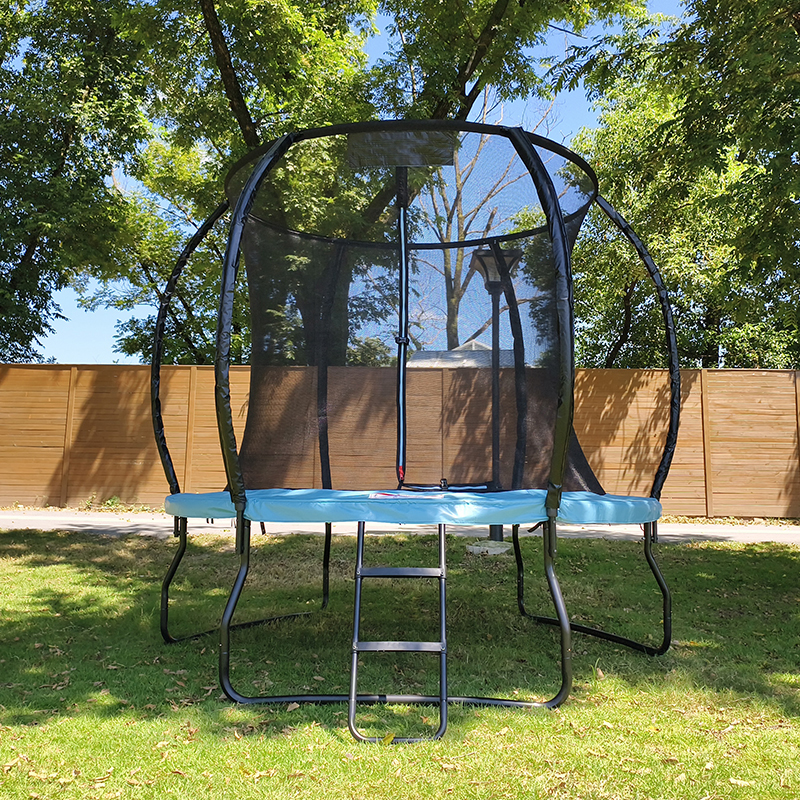
To pick the right size, you first must understand the unique geometry at play. A pumpkin shaped trampoline looks quite different from traditional straight-pole models. Standard designs pull the safety net straight down. This creates a tight vertical cylinder directly over the jumping mat. The pumpkin design utilizes a premium top-ring frame. This sturdy ring actively bows the netting outward, mimicking a pumpkin's curve.
A 12FT pumpkin mat covers the exact same ground surface area as a 12FT standard mat. However, the enclosure volume differs massively. The curved net significantly increases breathable upper-body space. Jumpers naturally swing their arms and tilt their torsos during mid-air maneuvers. The outward curve accommodates these wide movements perfectly. It drastically reduces frustrating net collisions.
This design advantage directly impacts your size selection. Buyers facing highly constrained yards often worry about losing jumping space. You might successfully downgrade one size category. For instance, you could step down from a 14FT to a 12FT model. The extra upper-body room ensures you never sacrifice the perceived jumping area. Kids feel unrestricted, and your yard retains usable lawn space for other activities.
Consider these structural benefits when evaluating your options:
Enhanced Spatial Perception: The wider top section makes the interior feel cavernous.
Reduced Edge Anxiety: Jumpers feel less cramped near the outer springs.
Better Airflow: The expanded mesh area allows stronger cross-breezes during hot summer days.
Before you order a specific dimension, you must evaluate your physical yard space thoroughly. Many buyers only measure the product diameter. They completely ignore the essential safety zones surrounding the equipment.
Industry-standard safety protocols demand a lateral safety perimeter. We call this the "Footprint Plus" rule. You must leave three to six feet of empty space around the entire frame. A 14FT Pumpkin Trampoline does not just take up 14 feet. It requires an actual yard clearance of 20 to 24 feet. This buffer accounts for the safe fall zone. It prevents jumpers from impacting fences, retaining walls, or sharp garden equipment.
Lateral space forms only half the sizing equation. You must calculate vertical clearance strictly. Experts recommend a minimum vertical clearance of 24 feet from ground level. Jumpers achieve surprising heights on high-tension mats. Check your intended installation spot carefully. Avoid low-hanging tree branches, sloped rooflines, and overhead power lines.
You must address implementation risks early. Frame tension degrades rapidly on unlevel ground. The larger the diameter, the harder leveling becomes. A massive 16FT model requires a huge expanse of perfectly flat grass. Even a slight slope causes uneven spring wear. It also pushes jumpers dangerously toward the lower edge of the mat.
Common mistakes during yard mapping include:
Ignoring hidden tree roots sticking above the soil.
Placing legs directly over shallow sprinkler lines.
Forgetting to account for the swinging radius of nearby gates.
Finding the sweet spot between footprint and functionality requires analyzing each size tier carefully. Review the breakdown below to match your specific household needs.
Backyard Space and Usage Tier Comparison
Dimension | Ideal User Group | Minimum Required Yard Space | Projected Lifespan |
|---|---|---|---|
10FT | Toddlers and kids under 8 | 16FT x 16FT | Short (Quickly outgrown) |
12FT | Pre-teens and average families | 18FT x 18FT | Medium to Long |
14FT | Teenagers and gymnasts | 20FT x 20FT | Long (Excellent investment) |
16FT | Athletes and large families | 22FT x 22FT | Maximum (Requires flat space) |
This size fits small urban courtyards easily. It works best for toddlers and children under eight years old. Parents appreciate the modest footprint. You can tuck it into tight corners safely, provided you leave a three-foot gap.
However, practical limitations become apparent quickly. Growing kids will outgrow a 10FT model fast. You must enforce strict single-jumper limitations. The immediate spring-rebound proximity leaves zero room for error. Multiple kids jumping here will inevitably collide.
Consider this the most balanced choice for medium-sized yards. It accommodates pre-teens and younger children beautifully. The outward-bowing net makes the jumping space feel highly generous.
The value proposition remains incredibly strong. You get excellent footprint efficiency alongside long-term usability. It provides enough surface area for learning basic tricks. Most average suburban yards handle this dimension without feeling overly cramped.
Teenagers and aspiring gymnasts thrive on this particular dimension. It demands large suburban yards for safe installation. The extra surface area gives users plenty of runway for tumbling passes.
The heavier frame provides superior stability during high-impact jumps. You experience maximum dynamic rebound here. The springs have enough length and tension to deliver serious airtime. This tier prevents older kids from feeling restricted during athletic routines.
Athletic training requires substantial room. Multi-child households also gravitate toward this massive model. You must strictly sequence their jumping, but they will enjoy the vast space. The massive surface acts as a professional-grade practice arena.
The risk factor scales up alongside the size. You absolutely require a massive, perfectly flat dedicated yard space. Assembly complexity hits its absolute peak here. Tensioning the mat on a 16FT frame takes serious physical effort.
Manufacturer marketing claims often confuse casual buyers. You might see a giant sticker boasting a 400-pound weight limit. Do not take these numbers at face value. You need to deconstruct these ratings carefully.
A stated 400-lb limit usually applies to static weight. This means placing 400 pounds of heavy sandbags gently on the mat. Dynamic load tells a completely different story. The downward kinetic force of a 150-lb teen landing a backflip multiplies their actual weight. This dynamic impact dictates your true size requirement. A heavier jumper needs a larger mat to absorb this intense kinetic energy safely without bottoming out.
Larger sizes technically support more total weight. This leads to a dangerous misconception. Parents assume a massive model safely holds four kids simultaneously. Safety standards for a pumpkin trampoline with safety net strictly dictate one jumper at a time. The expanded surface area does not eliminate the "bowling bowl effect." The heaviest jumper will always pull lighter jumpers toward them. This physics phenomenon causes severe collision injuries.
Look closely at the spring count-to-diameter ratio. Larger sizes require disproportionately more springs to maintain proper mat tension. A 14FT model equipped with too few springs feels sluggish and bottom-heavy. Always compare the spring count against the frame diameter before purchasing. A premium model packs high-tensile springs closely together.
You want this equipment to last throughout your children's active years. Strategic planning prevents early replacement headaches. Taking the time to forecast growth saves money.
Parents of young children often make a crucial error. They buy exactly what fits their five-year-old today. We strongly advise sizing up by one tier if your yard space permits. If you have the room, skip the 10FT and buy the 12FT. You avoid the massive hassle of replacing a small model in just three years. Kids grow fast, and their spatial needs expand even faster.
The unique top-ring design adds tremendous safety. However, it also increases installation difficulty. Large 14FT and 16FT models require significant physical effort. Frame tension at these wider sizes becomes incredibly strong.
Follow these specific assembly best practices:
Dedicate at least two able-bodied adults to the entire task.
Block out two to three solid hours for safe, unhurried assembly.
Use the specialized spring-pulling tool strictly according to the manual.
Attach springs in a star pattern to distribute tension evenly across the mat.
Remember basic aerodynamics. Larger surface areas act exactly like ship sails. A massive jumping mat catches strong wind gusts easily. You must mandate the inclusion of heavy-duty wind stakes for 14FT and larger sizes. Anchor the steel legs deeply into the dense soil. We recommend auger-style stakes over simple U-shaped pins. This prevents catastrophic storm damage to your yard and the equipment itself.
Choosing the ideal pumpkin trampoline size requires balancing available space with long-term usability. Select the 10FT model only for extreme space constraints. Opt for the 12FT or 14FT models to ensure standard family longevity and balanced dynamic rebound. Reserve the massive 16FT model exclusively for rigorous athletic training, provided you meet strict leveling criteria. Do not guess your available space. Grab a physical tape measure today. Walk out to your yard and map the exact diameter. Add the mandatory three-foot safety perimeter to your ground measurements. Confirm your overhead clearance carefully. Complete these physical checks before checking out your cart.
A: First, drive a small stake into the center of your desired location. Second, attach a tape measure and walk out the radius of the trampoline, plus an extra three feet for lateral safety clearance. Finally, look straight up to check vertical space. Ensure you have 24 feet of unobstructed height, completely free from branches or wires.
A: No, it does not. The ground footprint of the legs and frame remains identical to standard straight-pole models of the same diameter. The extra width exclusively exists suspended in the air. The curved net bows outward above the frame, giving you more breathable upper-body room without demanding extra lawn space.
A: Corner placements pose significant risks due to nearby fences. You should size down your selection. If you planned for a 14FT, buy a 12FT instead. This ensures you maintain a strict three-foot gap between the bulging net and the hard fence line. Never let the safety net rub against solid backyard structures.
A: It depends strictly on the manufacturer's dynamic weight limit and the overall spring quality, not just the physical diameter. Many premium 12FT models handle adult weights perfectly. However, you must check the dynamic load rating. If an adult exceeds this rating during high-impact jumps, they risk stretching the springs or bottoming out.


