

close
Choose Your Site
Global
Social Media

Author: Site Editor Publish Time: 2026-07-09 Origin: Site
Parents everywhere face a familiar daily hurdle. You need to manage your children's boundless energy levels. Yet, you also must balance physical safety and limited household space. This dilemma often brings you to a critical decision stage. Do you choose a compact, activity-focused indoor solution? Or do you invest in a traditional, high-recreation outdoor setup?
We know this choice feels overwhelming. Our goal is to provide an objective, evidence-based guide. The "best" choice depends entirely on your exact constraints. You must consider local climate, yard size, and HOA rules. You also need to evaluate your child's specific developmental needs. Let us explore how these two distinct equipment types serve entirely different purposes.
Purpose: Kids fitness trampolines prioritize controlled cardiovascular exercise and spatial awareness; outdoor trampolines focus on high-bounce recreation.
Space & Climate: Outdoor models require significant square footage and weather maintenance; indoor fitness models require minimal footprint and operate year-round.
Safety & Compliance: Outdoor models carry higher injury risks and potential home insurance implications, whereas indoor models offer tighter enclosure systems.
Lifespan & Cost: Traditional models face UV and rust degradation; indoor models last longer but have lower age/weight caps unless upgrading to professional shapes.
Understanding the mechanical differences between indoor and outdoor models is crucial. Manufacturers engineer each type for entirely distinct physical outcomes. They use different tension systems, frame materials, and mat architectures. These variations dictate how your child interacts safely during playtime.
A kids fitness trampoline relies on specialized mechanical designs. Most models utilize heavy-duty bungee cords. Some use specialized short steel springs. These components create a firmer, highly controlled bounce. The tension limits vertical lift. This intentional restriction keeps toddlers grounded and safe.
This design focuses heavily on developmental outcomes. Pediatric physical therapists frequently recommend controlled rebounding. The activity improves proprioception, spatial awareness, and core strength. Children burn intense energy indoors. However, the firm mat prevents them from launching dangerously high. This makes the equipment ideal for daily cardiovascular exercise. It acts as a targeted fitness tool rather than a mere toy.
Traditional outdoor models feature drastically different mechanics. They utilize dozens of long, coiled steel springs. These springs stretch wide across large surface areas. This architecture stores massive kinetic energy. The resulting bounce maximizes airtime. It provides the classic floating sensation older children crave.
The primary outcomes center around high-impact recreation. These models support advanced physical skills. Users practice gymnastics, aerial tricks, and athletic conditioning. They also encourage social play and outdoor engagement. Industry safety standards strongly recommend single-user jumping. Despite this, families often view large models as multi-user recreational hubs. The increased airtime inherently demands stricter adult supervision.
Physical footprint and environmental exposure dictate feasibility. You must evaluate your property realistically. Many buyers underestimate the spatial demands of outdoor equipment. They also overlook the hidden maintenance burdens tied to weather exposure.
Outdoor setups demand massive clearance zones. ASTM safety guidelines suggest lateral clearance around the entire perimeter. You need perfectly flat ground. Sloped yards require costly professional leveling. Furthermore, many Homeowner Associations (HOAs) enforce strict backyard restrictions. Some neighborhoods outright ban visible backyard play structures.
Indoor requirements present different challenges. Ceiling height is your primary constraint. Most experts recommend at least 8 feet of vertical clearance. You must also consider floor protection. Placing EVA foam mats underneath prevents hard-floor scratching. Noise transmission poses another hurdle. Apartment dwellers must consider downstairs neighbors. Heavy jumping creates structural vibrations. Specialized rubber feet mitigate this noise transfer effectively.
Environmental Requirements Comparison
Requirement Area | Outdoor Setup | Indoor Setup |
|---|---|---|
Overhead Clearance | 24 feet (No trees or wires) | 8 to 9 feet (Standard ceilings) |
Ground Surface | Flat grass or specialized mulch | Carpet or hard floor plus EVA mats |
Noise Factors | Neighborhood sound rules | Floor vibrations for lower levels |
Outdoor equipment suffers inevitable environmental degradation. Sunlight acts as a relentless destroyer. UV rays slowly degrade safety nets and polypropylene mats. Rain and humidity attack the metal components. Even zinc-galvanized frames eventually show rust spots. Winterizing requires significant labor. You must remove the mat and springs before heavy snowfall.
Indoor fitness models offer a zero-weather-maintenance reality. Climate control protects the materials indefinitely. You never worry about rust, UV rotting, or snow loads. The equipment remains accessible 365 days a year. Rain or freezing temperatures never interrupt your child's exercise routine.
Safety remains the absolute top priority for parents. Modern engineering has revolutionized enclosure architectures. We no longer rely solely on basic straight-pole netting. Upgraded geometric designs significantly reduce collision risks.
Traditional straight-pole nets present inherent flaws. The safety netting sits uncomfortably close to the rigid vertical poles. An off-balance jump often results in a harsh pole strike. Manufacturers try padding these poles. However, thin foam degrades quickly outdoors. This leaves the steel exposed. Children remain vulnerable to blunt force impacts during aggressive play.
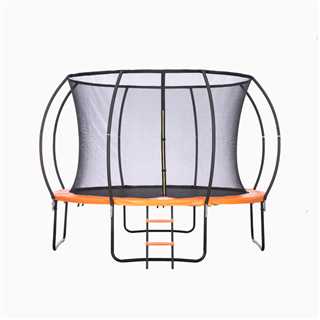
Innovative engineers solved this collision problem mathematically. They introduced the pumpkin trampoline design. This specific geometry features curved poles. The poles bulge outward, resembling a pumpkin's shape. The safety net pulls taut on the inside edge.
This architecture creates a massive safety buffer. The net catches the child long before they can hit the metal frame. The outward curve widens the upper spatial area. It feels less confining for energetic kids. The tension-based system absorbs kinetic energy safely. It redirects the child gently back to the mat center. This design dramatically lowers serious injury rates.
Common Mistake: Never allow children to intentionally throw themselves against any safety net. Nets serve as emergency fall protection. They are not primary rebounding surfaces.
Backyard equipment often triggers home insurance complications. Underwriters classify large outdoor jumps as "attractive nuisances." An unsecured backyard structure invites uninvited neighborhood children. If they injure themselves, you bear legal liability. Many insurers demand specific safety nets. Some require tall perimeter fencing. A few policies strictly exclude coverage entirely.
Indoor exercise equipment bypasses these insurance headaches. You secure the item behind locked doors. It poses zero risk to neighborhood children. Insurance companies classify these as standard household fitness goods. You avoid premium hikes and policy cancellations.
Children outgrow cheap toddler toys rapidly. Their weight increases, and their play becomes aggressive. Parents must anticipate this developmental shift. Upgrading ensures ongoing safety and unbroken exercise habits.
Standard toddler indoor models max out around 50 to 100 pounds. As kids age, joint impact forces multiply. A heavier child bottoms out on weak bungee cords. The mat strikes the floor. This causes severe ankle and knee stress. You must transition to durable fitness gear as children surpass 60 pounds.
Investing in a professional pumpkin trampoline changes the longevity equation completely. These units undergo rigorous third-party testing. They boast features normally reserved for commercial gyms.
Commercial-grade components: They utilize reinforced elastic bungees or high-tensile coated springs. These resist sagging over years of heavy use.
ASTM-certified materials: The fabrics use non-toxic, skin-safe materials. This matters deeply for indoor environments.
Reinforced mat stitching: Manufacturers use eight-row V-ring stitching. This prevents mat tearing under adult-level weights.
Heavy-gauge steel frames: The structural tubes resist bending during intense, off-center jumps.
Parents often hesitate at professional-grade price tags. You must consider the broader context. Investing slightly more upfront yields a vastly lower cost-per-use. Cheap models require frequent replacement. Upgraded indoor models last a decade. They survive multiple children. They provide consistent, safe indoor fitness long after cheaper versions fail.
Financial planning extends beyond the initial checkout cart. You must calculate replacement parts, seasonal labor, and disposal fees. A complete financial picture helps you avoid buyer's remorse.
Standard outdoor setups carry moderate to high entry prices. Size and brand dictate the exact cost. You pay for massive amounts of steel and netting. Kids fitness models cost significantly less initially. They use fewer materials. The smaller footprint drives down manufacturing and shipping expenses.
Outdoor setups drain wallets slowly over time. You must itemize necessary replacement parts. Sun-rotted spring covers require replacing every two years. Safety nets tear and lose tension. Wind stakes and heavy-duty anchors add upfront costs. Severe storms often bend frame poles. These parts cost nearly as much as a new unit.
Indoor setups eliminate these hidden costs. The environment preserves the materials. You rarely buy replacement parts. The initial purchase price generally represents your final expenditure.
Disposal presents a surprisingly frustrating challenge. Dismantling a rusted outdoor frame requires heavy tools and hours of labor. Landfills often charge premium disposal fees for bulk metal and bulky nets. Reselling them proves difficult. Buyers distrust used, weather-beaten safety nets.
Indoor fitness units offer incredible convenience. Moving them simply requires sliding them into a new room. Reselling them is highly profitable. Used buyers eagerly purchase pristine indoor equipment. The secondary market for well-maintained indoor fitness gear remains remarkably strong.
Your final choice requires brutal honesty about your lifestyle. We developed a straightforward decision framework. Align your household realities against these specific criteria.
Choose the Kids Fitness Trampoline If:
You lack a flat, fenced backyard.
You live in extreme climates involving heavy rain, snow, or high heat.
Your primary goal is daily, safe, supervised cardiovascular activity.
You cater primarily to younger, developing children.
You want to avoid home insurance complications entirely.
Choose the Outdoor Trampoline If:
You have older children (8+) practicing gymnastics.
Your kids demand high-impact recreation and multi-skill practice.
You have ample, flat backyard space.
You live in a region enjoying mild, predictable weather.
You are fully prepared to conduct routine structural safety checks.
Best Practice: Always measure your intended space before browsing brands. A tape measure prevents ninety percent of return hassles.
We must reiterate one final truth. Neither option is inherently superior. Success depends entirely on matching the product to your family infrastructure. Your risk tolerance and maintenance willingness play massive roles in this decision. An outdoor model offers unparalleled recreational joy and advanced skill development. An indoor fitness model provides consistent, climate-proof cardiovascular health and sensory regulation.
Evaluate your available space immediately. Grab a tape measure today. Measure your indoor ceiling heights carefully. Alternatively, map out your outdoor yard clearance zones. Use these exact dimensions as your foundational starting point. Once you define your physical boundaries, you can confidently evaluate specific brands and geometries.
A: We strongly advise against this. Indoor-specific materials lack robust UV inhibitors. Direct sunlight degrades the elastic bungee cords and polypropylene mats rapidly. Moisture also rusts the untreated steel joints. If you must use it outside temporarily, bring it indoors immediately after playtime ends.
A: Yes. The outward-curving pole physics drastically reduce impact injuries. The net pulls tight internally while the rigid steel poles bulge outward. This geometry creates a wide safety buffer. A falling child impacts the soft, tension-absorbing net long before touching the dangerous metal frame.
A: These professional-grade models serve a broad age range, typically from 4 to 12 years old. They feature higher weight capacities and commercial-grade bungees. This sturdy construction supports aggressive jumping safely. It perfectly accommodates a child’s joint development and increasing body mass over many years.
A: Often, yes. Insurers frequently classify them as an "attractive nuisance." Uninvited neighborhood children might wander into your yard and jump. If they sustain injuries, you face legal liability. Always consult your insurance agent beforehand. They might require safety nets, locked fences, or specific liability riders.


