

close
Choose Your Site
Global
Social Media

Author: Site Editor Publish Time: 2026-07-04 Origin: Site
Every parent faces a frustrating dilemma when planning a backyard play area. You want to invest hard-earned money and valuable outdoor space into play equipment. You also constantly worry about the dreaded "boredom factor" or rapid hardware wear and tear. Over the past decade, we have seen a massive shift in backyard play trends. Basic A-frame structures have rapidly evolved into massive, multi-feature playsets. However, bigger does not always mean better for your specific household.
The real challenge is not about finding the universally best set on the market. Instead, it involves finding the exact match for your family's yard size, budget constraints, and children's developmental stages. A towering structure might impress neighbors, but it could overwhelm a small yard or sit unused by older kids. In this guide, you will learn how to evaluate structural mechanics, safety footprints, and play density. We will help you navigate material choices and avoid hidden installation risks. You will leave with a clear roadmap to make a confident, lasting backyard investment.
Engagement lifespan: An outdoor swing slide set offers multimodal play, generally retaining child interest 2–3 years longer than a traditional setup.
Space requirements: Traditional sets require a linear safety zone; slide combinations require a wider, 360-degree clearance footprint.
Maintenance reality: Feature-rich sets demand more intensive site prep and assembly, while simpler sets (especially a powder-coated metal swing set) offer faster deployment and easier upkeep.
Cost vs. ROI: Multi-feature sets have a higher upfront cost but often yield a lower "cost-per-hour" of play over a 5-to-10-year horizon.
We must first distinguish between the two primary categories of play equipment. Each type serves very different developmental needs. They also offer unique physical benefits for growing bodies.
A traditional setup relies on a classic A-frame design. It typically supports two to three swinging accessories across a top horizontal beam. These attachments usually include standard belt swings, trapeze bars, or infant bucket seats.
Its primary function delivers pure vestibular stimulation. Children experience simple, single-axis movement. They swing forward and backward in a highly predictable pendulum arc. This straightforward mechanic offers excellent sensory input. It builds core body strength and improves spatial balance. Because it isolates one type of movement, kids focus entirely on mastering their pumping rhythm and height limits.
These units feature a much larger, hybrid footprint. They combine a traditional A-frame swing beam with a central elevated fort or tower structure. You will usually find climbing elements, a shaded canopy, and a backyard swing slide seamlessly integrated into the central tower.
Their primary function focuses on multimodal play. Kids engage in vestibular, proprioceptive, and imaginative activities all in one place. They climb up rock walls, navigate wooden decks, and slide down rapidly. This robust design easily supports simultaneous use by larger groups. It transforms a simple yard into a comprehensive neighborhood playground.
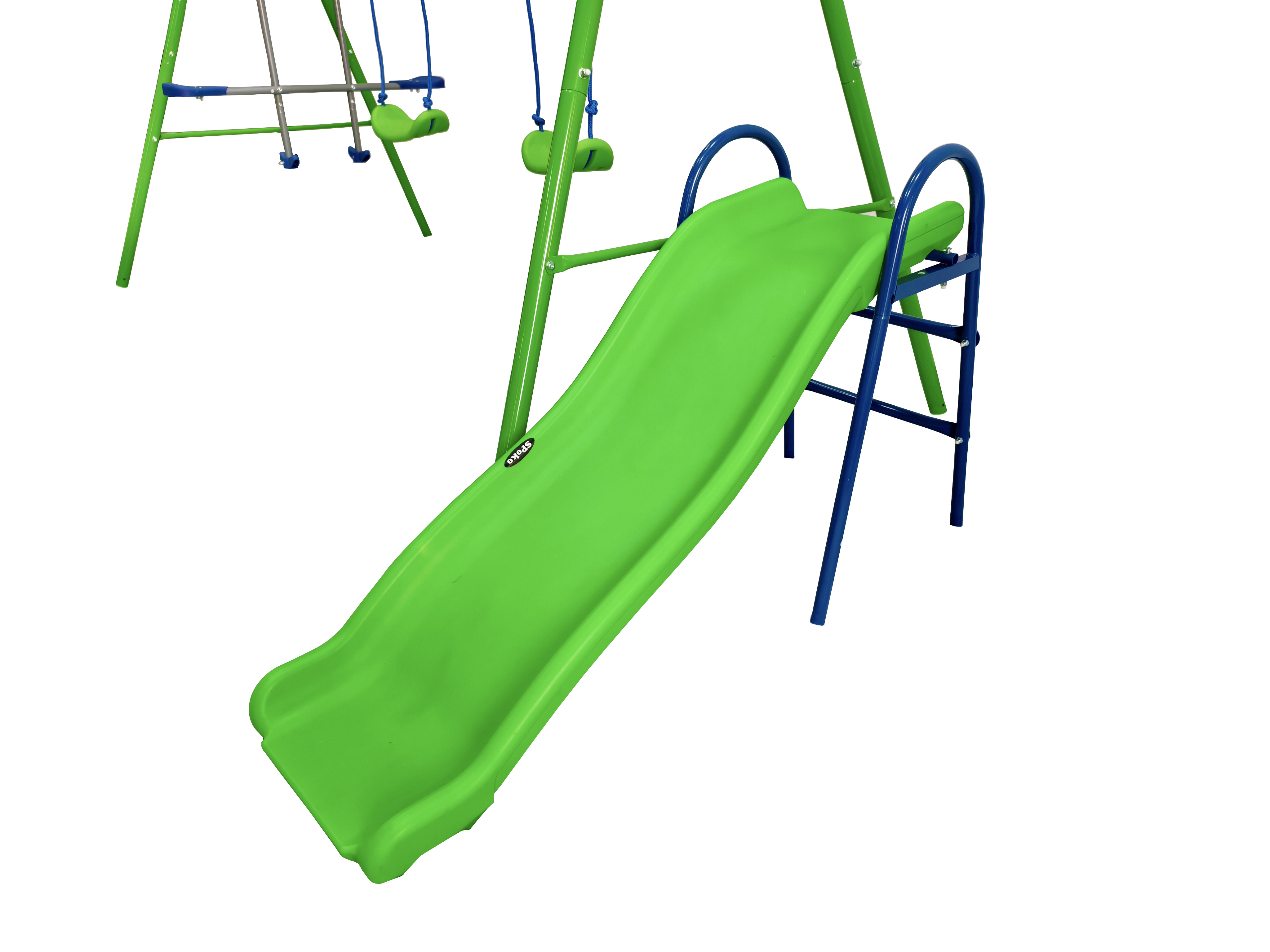
Before buying any heavy equipment, you need to assess your physical environment. You must also consider who will use the structure and for how many years.
Safety compliance dictates your final placement. Standard industry safety rules require at least 6 feet of clearance in all directions from the equipment's outermost edge. This buffer zone prevents dangerous collisions and allows safe dismounts.
You must understand directional versus perimeter impact. Swings require long front-to-back clearance. A child leaping from a moving swing needs a massive forward runaway zone. Adding a slide fundamentally changes the spatial geometry. It creates a complex safety perimeter. You suddenly have strict 360-degree clearance rules to manage. A slide exit needs a dedicated safe space completely separate from the active swing path.
Best Practice: Use marking paint or garden hoses to outline the absolute perimeter in your yard before ordering.
Children grow incredibly fast. Their play preferences shift drastically within just a few years. Buying for today might leave them bored tomorrow.
Toddler to Early Elementary (Ages 3-7): Kids in this range show peak engagement with multi-feature sets. They love navigating slides, hiding in enclosed forts, and scaling small rock walls. The variety keeps them highly engaged. They move quickly from one activity station to the next, burning off energy.
Pre-teens (Ages 8-12): Older children quickly outgrow compact forts and short slides. They develop a higher preference for high-weight-capacity traditional swings. They also prefer specialized sensory attachments like wide web swings or standing swings. They seek intense physical input rather than imaginative role-play.
Material choice directly determines your annual maintenance schedule and long-term safety.
Wood: Wooden structures look highly aesthetically pleasing. They blend beautifully into natural backyard landscaping. They are also highly customizable. However, wood is inherently susceptible to rot, moisture warping, and insect damage. You must commit to annual sealing and staining to prevent structural decay.
Metal: A modern, heavy-duty metal swing set eliminates rot and splinter risks entirely. These structures often require much less routine maintenance. Provided the factory powder coating remains scratch-resistant, rust stays away. Thick-gauge metal frames handle heavy dynamic loads exceptionally well, making them ideal for older kids.
Sometimes a minimal approach delivers the best long-term results. A basic A-frame holds immense value for modern homeowners. It presents the lowest barrier to entry. It also causes minimal visual obstruction in carefully planned landscaping.
Consider these primary advantages:
Highly cost-effective: You spend a fraction of the cost compared to massive playsets.
Faster assembly: Two adults can typically construct it in under four hours using minimal hand tools.
Easier relocation: You can quickly dismantle or move it across the yard. You can easily remove it entirely when your children age out.
However, you must weigh these notable drawbacks:
Faster habituation: A single-activity focus often leads to a rapid loss of interest. Kids get bored faster when they can only swing.
Limited capacity: Multiple children struggle to play simultaneously. It often causes conflict, sharing issues, or bottlenecking during busy playdates.
When you invest in a multi-feature structure, you create an engaging backyard destination. This choice delivers substantial value by delaying the need to upgrade equipment as your children grow. An outdoor swing slide set offers varied physical challenges that evolve alongside your child's developing motor skills.
You can expect these compelling benefits:
High play density: It easily accommodates varied physical abilities. Kids can practice climbing, sliding, and swinging in one seamless session.
Social facilitation: Manufacturers specifically design these sets for multi-child households. Playdates run smoothly because everyone finds an open activity station.
Modular potential: You can easily swap out a toddler bucket seat for a standard belt swing. You keep the core climbing structure intact while adapting to older age groups.
You must also prepare for specific disadvantages:
Significant spatial dominance: It heavily dominates your yard footprint. You sacrifice valuable open lawn space.
Structural settling vulnerability: The heavy central tower requires a perfectly leveled yard. Uneven ground causes torqued hardware joints and unstable platforms over time.
Common Mistake: Eyeballing the ground level. Even a two-inch slope can severely compromise the stability of a tall central tower.
Purchasing the equipment is only the very first step. Installation brings entirely separate logistical challenges. Many buyers completely overlook the physical and financial demands of site preparation.
Traditional frames are highly DIY-friendly. You only need basic socket wrenches and a free afternoon. Slide sets tell a completely different story. They often require two to three capable adults working over a full weekend. Many thousands of hardware pieces require sorting and strict adherence to manuals. If you lack patience, you face a $300 to $600 premium to hire professional installers.
You cannot simply drop a large playset onto uneven grass. Costs scale up drastically for larger units. You must pay for mechanically leveling the ground. You need to lay commercial-grade weed barriers to prevent overgrowth. You also must install compliant safety surfacing. Popular options include shredded rubber mulch, smooth pea gravel, or engineered wood chips. These safety materials easily add hundreds of dollars to your final budget.
Every bolt and screw represents a potential point of loosening. Complex sets have significantly more hardware joints. You must torque them annually to prevent dangerous wobbling. Larger structures also expose more surface area to severe UV degradation. Sunscreen, pollen, and dirt build up rapidly on plastic slides. Fabric canopies often tear in high winter winds. You must factor this yearly physical upkeep into your buying decision.
We developed a clear framework to help you decide. You must ruthlessly compare your household realities against the ideal environments for each type of equipment.
Review the breakdown below to guide your final choice based on physical constraints and budget.
Consideration Factor | Traditional Setup | Slide & Swing Combination |
|---|---|---|
Available Clearance Space | Requires long, narrow linear space | Requires wide, 360-degree footprint |
Primary Age Group | Best for older kids (8+) or quick sensory input | Best for toddlers to early elementary (3-7) |
Assembly Time | 2 to 4 hours (DIY friendly) | 12 to 24 hours (Full weekend project) |
Budget Constraints | Strictly under $500 | Requires $1000+ including safety surfacing |
Follow these specific guidelines to pinpoint your ideal fit:
Opt for a Traditional Setup if: Your primary constraint is a narrow, sloped, or highly unlevel yard. Your budget is strictly under $500. You are buying primarily for older children seeking intense vestibular swinging input.
Opt for a Multi-Feature Setup if: You have an open, flat clearance zone measuring at least 25 by 25 feet. You want to maximize multi-year engagement for toddlers and active preschoolers. You frequently host multiple children and need varied activity stations to prevent arguments.
Neither play option reigns universally superior. The absolute right choice hinges entirely on aligning the equipment's capabilities with your specific spatial, financial, and family dynamics. A minimal frame offers quick setup and high durability for older thrill-seekers. Conversely, a massive hybrid fort provides unmatched imaginative play for younger siblings.
Your next step is highly practical. Grab a tape measure and accurately map your available level ground. Factor in the mandatory 6-foot safety perimeter around all open sides. Decide your actual appetite for a rigorous weekend assembly project. Only after answering these physical constraints should you start browsing specific product models online.
A: Generally no, unless the set was specifically engineered as a modular system. Modifying a basic A-frame by bolting on heavy accessories compromises its structural integrity. It shifts the center of gravity dangerously and almost always voids manufacturer warranties.
A: A galvanized metal swing set typically requires less maintenance and completely avoids rot or insect damage. However, premium cedar sets can comfortably last 10–15 years if you properly stain and seal the wood annually to block moisture.
A: Engineered wood fiber, rubber mulch, or poured-in-place rubber offer the best impact attenuation for falls. Grass is generally not considered a compliant or safe surface for fall heights over 3 feet due to soil compaction over time.


