

close
Choose Your Site
Global
Social Media

Author: Site Editor Publish Time: 2026-09-22 Origin: Site
Rectangular trampolines deliver incredible bounce dynamics and unmatched spatial efficiency. However, their elongated footprint demands rigorous yard planning before installation. Purchasing a unit before validating yard compatibility often creates severe safety hazards. It can also lead to frustrating, expensive returns.
You cannot simply squeeze an outdoor rectangular trampoline into leftover lawn space. Proper evaluation requires precise calculations. You must account for lateral clearance, vertical obstructions, and ground leveling. Ignoring these factors compromises structural integrity and user safety.
This guide provides a definitive framework to evaluate your yard layout. You will learn to measure required clearance zones accurately. Ultimately, we will help you determine if a rectangular model is the safest, most viable option for your outdoor space.
Footprint vs. Dimensions: The actual space required is the trampoline's physical dimension plus a mandatory 3 to 5-foot lateral safety zone on all sides.
Ideal for Narrow Spaces: Rectangular shapes utilize long, narrow yard layouts (like side yards) much more efficiently than round alternatives.
Vertical Clearance is Non-Negotiable: A minimum of 24 feet of overhead clearance is required to avoid tree branches and power lines.
Level Ground is Critical: Slopes greater than 1-2 inches demand professional leveling or trenching to prevent frame warping and uneven bounce distribution.
Many homeowners make a critical mistake during the purchasing process. They measure their yard based solely on the product dimensions listed on the box. This oversight leads to cramped installations. To ensure safety, you must distinguish between the frame dimensions and the safe use zone.
Consider a standard 10x17 foot frame. You might think a 10x17 foot patch of grass is sufficient. Industry safety protocols, including ASTM standards, require a minimum lateral safety zone. You must calculate the true footprint using these steps:
Note the exact length and width of the steel frame.
Add a minimum of 3 feet (ideally 5 feet) to every single side.
Calculate the final required footprint.
Following this formula, a 10x17 foot unit actually demands a 16x23 foot minimum yard footprint. The lateral clearance rule exists to protect jumpers. You must keep the frame 3 to 5 feet away from hard obstacles. These obstacles include wooden fences, metal sheds, brick retaining walls, and swimming pools. Hitting a hard structure during a fall causes severe injuries.
You must also account for the enclosure. A modern rectangular trampoline with safety net requires extra breathing room. When a jumper falls against the enclosure, the net bows outward. The fiberglass or steel poles flex under pressure. If you place the frame too close to a fence, the stretching net will smash the jumper directly into the wood or metal. This outward bowing mechanism dictates why the lateral clearance rule is non-negotiable during active use.
Different yard shapes dictate different installation strategies. A rectangular trampoline excels in specific environments. We can break these down into three primary layout categories.
Long, narrow properties often struggle to accommodate bulky round frames. The corridor layout is where elongated frames shine. The straight edges naturally align parallel to your property lines. This alignment pushes the equipment to the perimeter.
This strategy preserves the center lawn. You retain valuable open space for hosting, playing soccer, or gardening. It also maximizes otherwise dead real estate along side fences. As long as you maintain the mandatory lateral safety clearance, side yards transform into highly efficient bounce zones.
Many landscape designs utilize a zoned approach. Integrating the frame into a dedicated play zone keeps the yard organized. You might group it near a swing set or a sandbox. The corner strategy works well for this.
Angle placement requires careful consideration. You should position the long side of the frame parallel to your primary sightline. If you watch your kids from the kitchen window or the patio couch, the long side offers the best visibility. This angle ensures unobstructed supervision across the entire jump mat.
Massive yards offer absolute freedom, but they present unique challenges. Open acreage lacks natural windbreaks. You must position the frame away from primary wind corridors. High winds easily flip unsecured frames.
Strategic placement over impact-absorbing ground is vital. You have choices between natural turf and engineered wood fiber. Avoid placing the unit in the middle of a pristine, manicured lawn if you hate moving heavy equipment. Instead, dedicate a specific quadrant of the acreage solely for recreation.
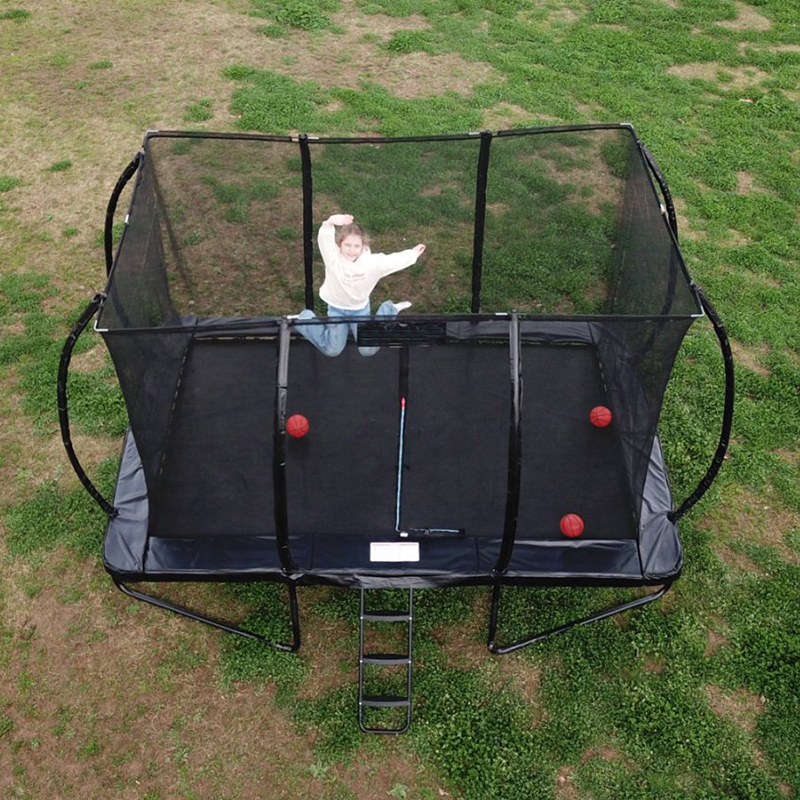
The ground beneath the frame dictates the longevity of the equipment. Rectangular frames possess a unique structural dynamic. They are highly susceptible to twisting if placed on uneven ground. A round frame distributes weight evenly in a circle. An elongated frame bears load disparately across its corners and straight sections.
The leveling mandate is absolute. You must measure the gradient of your yard. Use a long piece of timber and a carpenter's level. Place the timber across the intended installation site. If the slope drops more than 1 to 2 inches across the entire span, you have a problem. Placing a frame on a severe slope voids manufacturer warranties. It introduces severe safety risks. The frame will warp, the bounce will pull jumpers downhill, and the legs may buckle.
You must evaluate the surface type carefully. Each surface offers distinct advantages and significant drawbacks. Review the comparison table below before making a final decision.
Table: Surface Type Comparison for Placement
Surface Type | Shock Absorption | Maintenance Effort | Recommendation Level |
|---|---|---|---|
Grass / Turf | Excellent natural cushioning during falls. | High. Requires moving the frame to mow beneath it regularly. | Highly Recommended |
Bark / Mulch Beds | Good. Provides a soft landing zone if deep enough. | Medium. Requires retaining borders to keep mulch contained. | Recommended for Zoned Yards |
Concrete / Paving | None. High impact risk for falls. | Low. No mowing required. | Not Recommended (Unless modified) |
As the table outlines, grass offers the best natural shock absorption. Bark beds work excellently for dedicated play zones, though they require wooden or stone borders. Concrete is strictly discouraged. If you absolutely must use a paved surface, you face heavy implementation risks. You will need thick rubber matting. You must also install specific anchoring systems, such as sandbags, to prevent the frame from sliding. Furthermore, constant friction against concrete grinds down the metal legs quickly.
Looking at the ground is only half the battle. You must assess the airspace above and the soil below. Vertical clearance realities often ruin perfect lawn setups. Safety organizations mandate a 24-foot overhead clearance zone. This height prevents ambitious jumpers from striking objects mid-air.
Map your mature tree canopy growth. A small sapling today becomes a sprawling oak in five years. Look for low-hanging roof eaves extending from your house or garage. Scan the yard for overhead utility lines. Bouncing into a power line is a fatal mistake. Always look directly up from your planned footprint.
Underground obstacles pose equally dangerous threats. Heavy outdoor frames sink over time. Evaluating the risk of placing heavy equipment over shallow utilities is critical. Do not place the legs directly over shallow septic lines or PVC sprinkler systems. The constant downward force from heavy jumping easily cracks plastic pipes. Additionally, avoid invasive tree roots. Thick surface roots destabilize the legs, causing the frame to rock dangerously during use.
Finally, analyze the sun and wind factors in your yard. Map the shade patterns throughout the day. Continuous, direct sunlight causes severe UV degradation. UV rays break down the safety net mesh and weaken the jump mat stitching. Positioning the frame in partial afternoon shade extends its lifespan significantly. Wind tunneling is another hidden danger. Narrow yard corridors often funnel wind at high speeds. A tightly woven safety net catches this wind like a sail, increasing the risk of the frame tipping over during severe storms.
After evaluating footprints, ground conditions, and obstructions, you must finalize your shape. Sometimes, a rectangular layout is perfect. Other times, the yard dictates a different approach.
You should shortlist a rectangular model when:
You have a linear yard layout. The long, straight lines of the frame complement the narrow corridors of your property perfectly.
You have athletes or gymnasts in the family. These shapes provide an even, independent bounce across the entire mat. The springs work independently, preventing jumpers from being pulled to the center.
You can absolutely guarantee the 3 to 5-foot lateral safety perimeter. You have measured the space and confirmed no fences or walls infringe on the bowing zone.
You should pivot to an alternative shape when:
Your available space is a perfect square. If you have a square zone, a square frame maximizes the jump area much better than an elongated one.
Your yard features irregular, curving borders. Winding garden beds and circular patios better accommodate the centralized footprint of a round model.
You have a significantly sloped rectangular zone. If you are unwilling or unable to hire professionals to level the ground, do not force a rectangular frame into the space. A severely sloped site guarantees frame damage and structural failure.
Securing a safe outdoor jumping environment requires moving far beyond basic box measurements. A successful installation demands a comprehensive evaluation of dynamic safety zones. You must factor in the bowing of the safety net. You must scrutinize ground conditions, ensuring a perfectly level surface. Finally, mapping overhead and underground clearance ensures long-term safety and durability.
Your immediate next step is practical action. Grab a measuring tape and some highly visible yard tape this weekend. Mark out the physical dimensions of the frame on your grass. Then, measure and tape an additional 5-foot clearance perimeter around that box. Step back and inspect the taped zone. If the tape touches your fences, crosses a steep slope, or sits directly under low tree branches, stop immediately. You must re-evaluate your yard layout or choose a smaller size before making a purchase.
A: Yes, provided you maintain at least 3-5 feet of clearance from both intersecting fences to allow the safety net to flex and prevent injury. Never push the frame flush against the corner boards.
A: Yes. Uneven weight distribution on a rectangular frame causes structural fatigue, compromises the bounce quality, and poses a serious tipping risk. Always level the ground before assembly.
A: Even with an enclosure, standard safety protocols require a minimum of 3 feet (ideally 5 feet) of lateral clearance from all hard structures to account for net displacement during falls.


